Let's grow a beautiful underwater jungle together, one tiny leaf at a time!
When aquarium plants are hungry, they rarely shout. They whisper through leaf color, texture, and little holes or tears that seem to appear overnight. This guide helps you read those clues and choose fixes that actually match what the plant is asking for.
Before blaming nutrients: a quick reality check
Deficiencies are common, but a few lookalikes can trick even careful aquascapers. Take a minute or two to rule these out first.
- Normal leaf shedding after planting: Many plants drop older emersed-grown leaves while they convert to submerged growth. This is especially common in crypts and some stems. If new submerged leaves look better each week, it may be transition rather than deficiency. (More on plant transitions here: /transitioning-emersed-aquarium-plants/.)
- Crypt melt: Cryptocoryne can suddenly turn translucent and collapse after changes in light, substrate, or parameters. It can look like a nutrient issue, but the pattern is different. (Guide: /understanding-cryptocoryne-melt/.)
- Algae or biofilm damage: Black beard algae can roughen leaf edges and cause tissue loss that resembles holes. (Help: /how-to-get-rid-of-black-beard-algae-bba-in-planted-tanks/.)
- Herbivores and pickers: Some fish and snails rasp soft leaves. True deficiency holes usually start as pinholes or weak spots within the leaf, not clean bites from the edge.
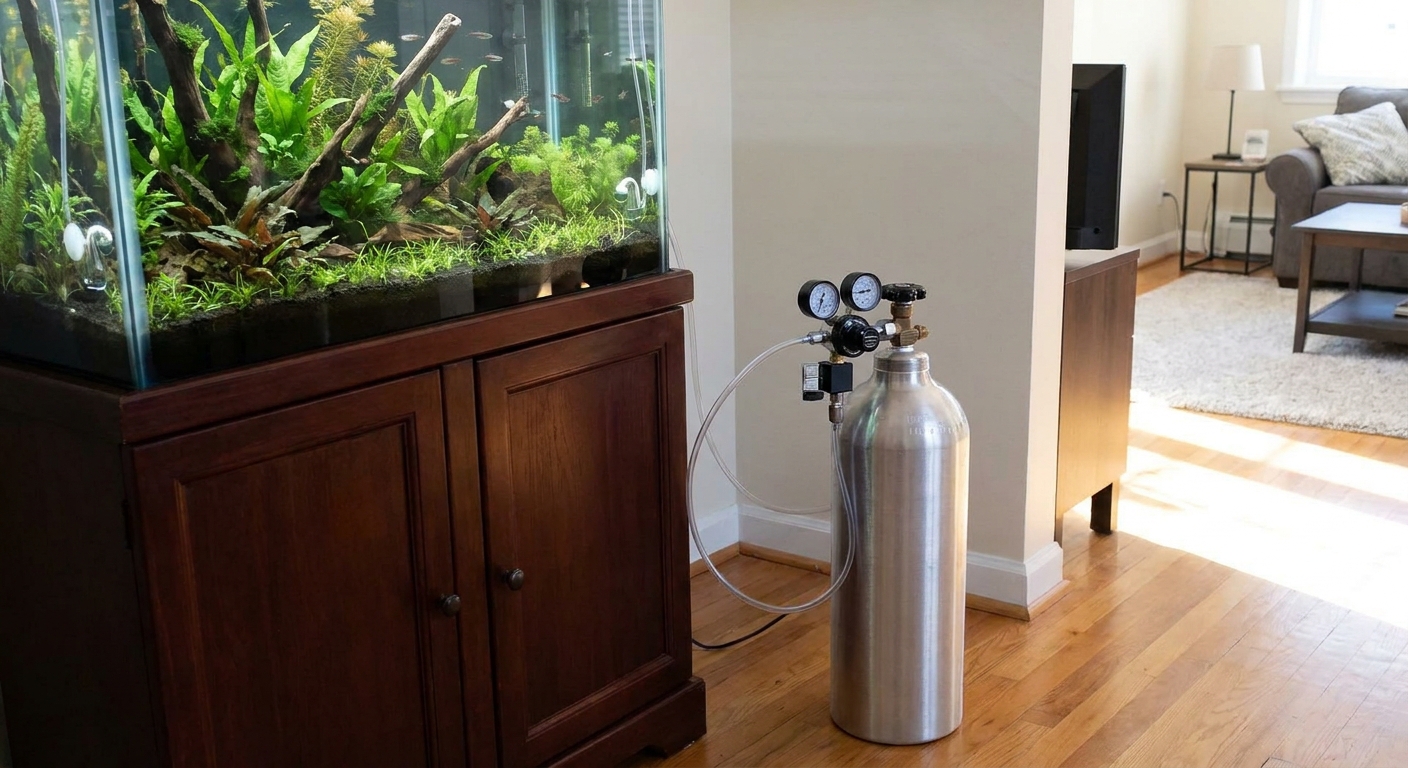
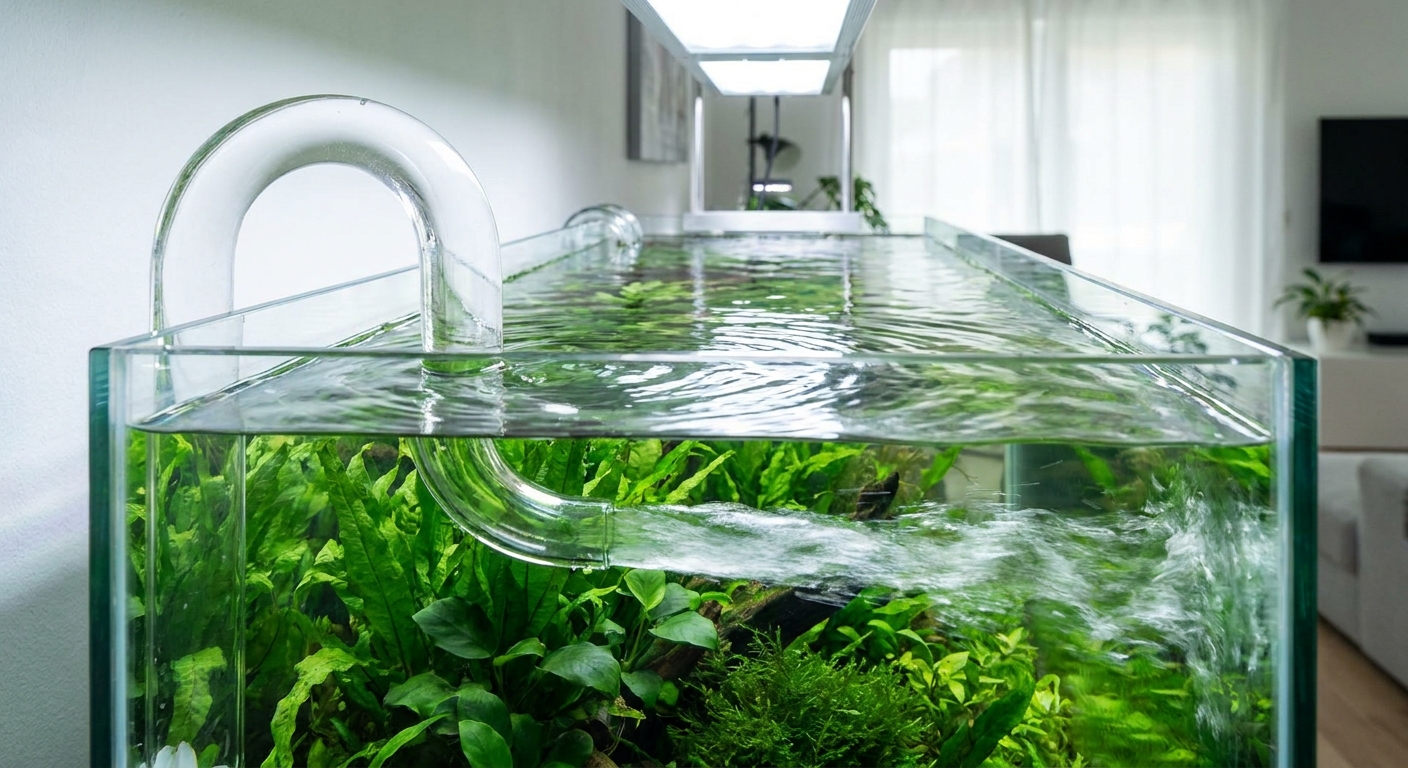
- CO2 and flow issues: Plants can be well-fed but still fail if carbon or circulation is weak, leading to stunting and melting that gets misread as deficiency. (CO2 setup: /pressurized-co2-setup-for-planted-aquariums/, circulation: /water-circulation-with-lily-pipes-and-surface-skimmers/.)
The most useful clue: old leaves or new leaves?
Here is the tiny trick that makes deficiency diagnosis much easier.
- Problems start on older leaves first: often a deficiency of a mobile nutrient the plant can move around (like nitrogen, phosphorus, potassium, magnesium).
- Problems start on new growth first: often a deficiency of an immobile nutrient the plant cannot easily move (like iron and calcium), or a broader “trace” issue.
If you remember only one thing, remember this: older leaves often point to macros, newer leaves often point to micros. It is a great shortcut, not a perfect rule. CO2 and light stress can mimic both, and some trace issues (like manganese or boron) also show up mostly on new growth.
Visual guide: yellowing leaves (chlorosis)
1) Overall yellowing on older leaves: Nitrogen (N) deficiency
What you see: Older leaves fade from green to pale yellow. Growth slows. Stem plants may drop lower leaves and look bare at the base.
Where it shows first: Older leaves.
Common triggers: Light is strong but feeding is light, low stocking, heavy water changes with very lean dosing, or a new tank that is not yet producing much nitrogenous waste.
Fix: Increase nitrogen via a complete all-in-one fertilizer or a macro dosing routine. Keep changes steady for 1 to 2 weeks so plants can respond. If algae is already present, avoid huge jumps. Raise gradually.
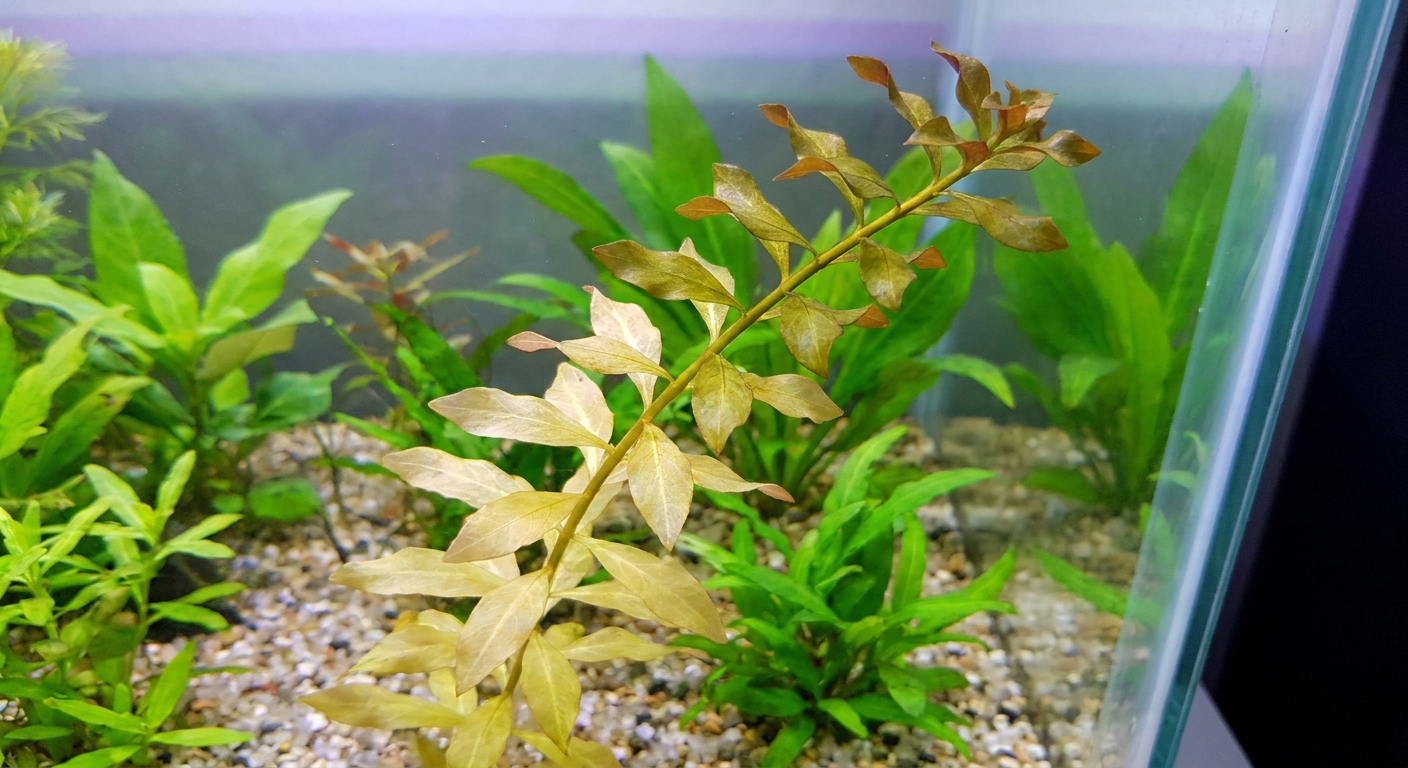
2) Yellow leaves with green veins on older leaves: Magnesium (Mg) deficiency
What you see: Interveinal chlorosis, meaning the leaf tissue turns yellow while veins stay green. Leaves may look striped or mottled.
Where it shows first: Older leaves.
Common triggers: Very soft water with low GH, or a tank that uses a lot of potassium and calcium while magnesium stays low.
Fix: Ensure GH is in a reasonable range for planted tanks and livestock, then add magnesium if needed. Many GH boosters include magnesium. Consistency matters more than chasing an exact number.
3) Pale new leaves or white new growth: Iron (Fe) or trace deficiency
What you see: New leaves emerge very light green, yellow, or nearly white. Veins can remain slightly greener than the tissue. Red plants often lose intensity and shift toward orange or pale pink.
Where it shows first: Newest growth tips.
Common triggers: Low micronutrient dosing, or high pH paired with higher alkalinity that makes iron harder to keep in a plant-available form unless it is well-chelated. Sometimes this also shows up in tanks where overall macros are pushed but trace dosing is not keeping pace.
Fix: Increase trace or micronutrients slowly. If using a separate iron supplement, dose lightly and watch for algae response. In higher pH and higher alkalinity tanks, a quality trace mix with chelated iron is often more reliable than trying to “force” iron with big doses.
Quick note: Iron test kits can be finicky, especially with chelated iron. In many tanks, observation plus consistent dosing tells you more than chasing a single Fe reading.
If you are chasing better reds, balance matters: light, CO2, and nutrition work together. A helpful overview lives here: /how-to-make-aquarium-plants-red/.
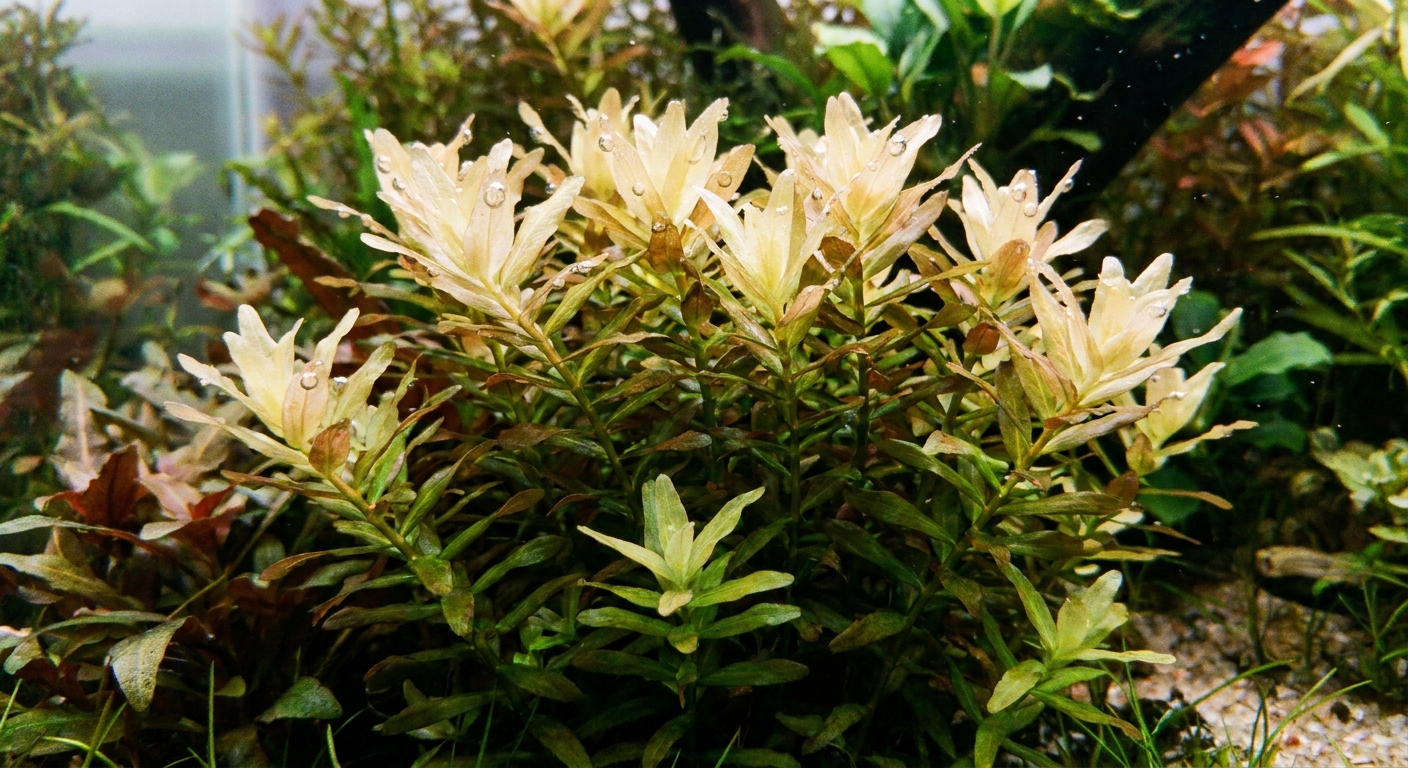
4) New leaves twist, crinkle, or die back: Calcium (Ca) deficiency (or meristem stress)
What you see: Distorted new leaves, twisted tips, and sometimes pinched growth. In severe cases, the growing point stops.
Where it shows first: New growth.
Common triggers: Extremely low GH, RO water without remineralization, or very rapid plant growth under strong light and CO2 without enough minerals.
Also consider: Boron deficiency (rare if you dose a complete trace mix) and damage from unstable CO2 can look similar at the growth tip.
Fix: Remineralize if using RO, and bring GH to a stable, livestock-safe level. Calcium is usually corrected through remineralizers or GH boosters rather than spot dosing alone.
5) Yellowing on new leaves with green veins: Iron (Fe) or manganese (Mn)
What you see: New leaves look yellowish while the veins remain greener. Sometimes manganese deficiency adds tiny specks of dead tissue on new leaves.
Where it shows first: New growth.
Fix: Treat this as a trace issue first. A complete micronutrient mix is usually safer than chasing individual elements unless you are very confident in the pattern.
Visual guide: pinholes, tears, and holes in leaves
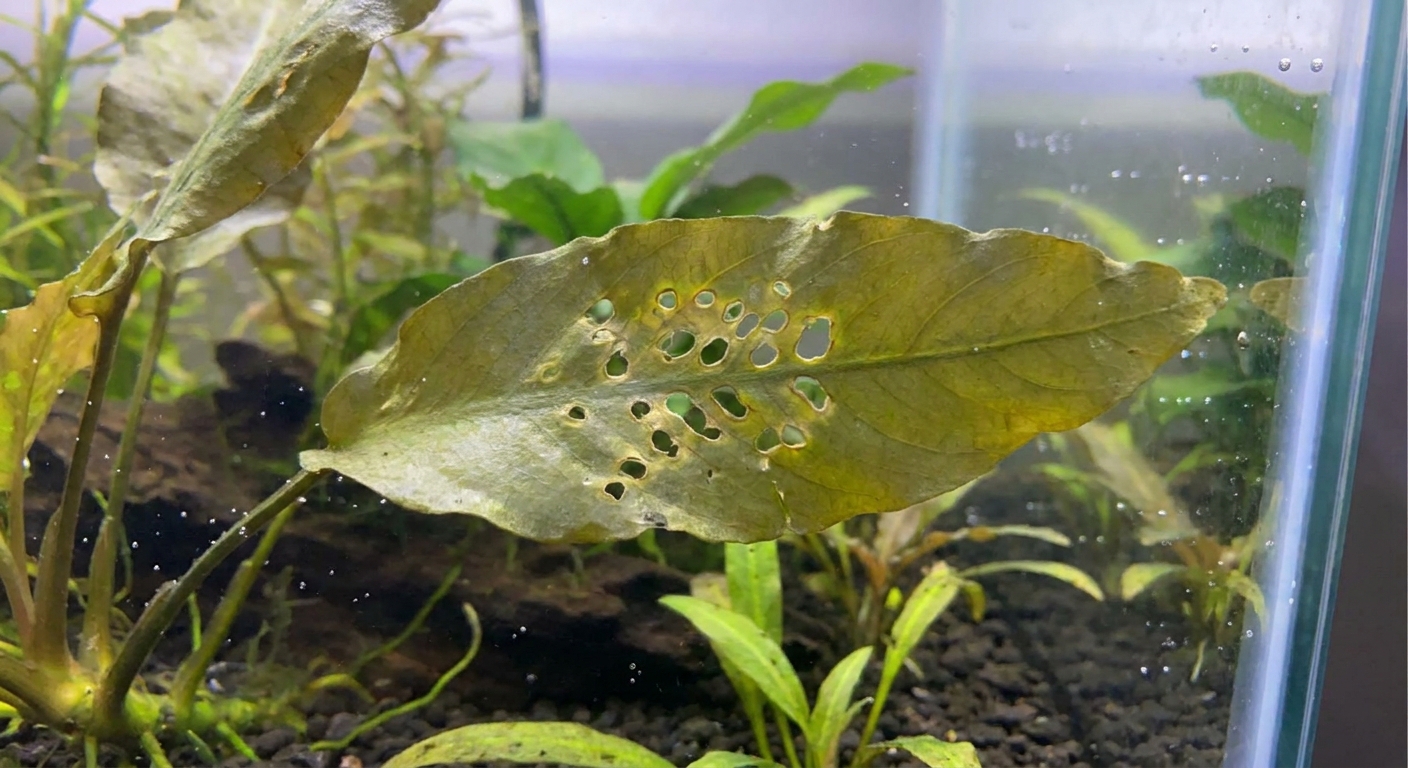
1) Pinholes and weak spots that turn into ragged holes: possible potassium (K) deficiency
What you see: Small weak spots, pinholes, or localized dead tissue within the leaf blade that later widen into irregular holes, sometimes with a yellow rim. Older leaves are usually hit first.
Where it shows first: Older leaves.
Common triggers: Lean dosing, heavy plant mass, or a tank that receives nitrogen and phosphate but little potassium.
Important: Potassium is one of the most over-diagnosed “leaf hole” causes in the hobby. If the damage is random (one plant, one leaf) it is often mechanical, algae-related tissue loss, or a localized CO2 and flow problem. Potassium becomes a stronger suspect when you see the same pattern repeating across multiple plants and multiple older leaves.
Fix: Increase potassium via an all-in-one fertilizer that includes K, or supplement K modestly alongside your current routine. Expect damaged leaves to stay damaged. Look for improvement in new leaves.
2) Slow growth and dulling on older leaves: Phosphorus (P) deficiency (rare)
What you see: Growth slows, leaves can look dull, and some plants darken or bronze rather than yellow. In some cases, older leaves may develop dead patches that later break into holes, but holes are not the most reliable clue by themselves.
Where it shows first: Often older leaves and overall growth rate.
Common triggers: Very lean phosphate dosing, aggressive removal via certain media, or extremely low feeding in lightly stocked tanks.
Fix: Add phosphate through a complete fertilizer or a macro routine. Avoid big spikes. Stability beats sudden corrections.
3) Clean semicircle bites on edges: livestock, not deficiency
What you see: Smooth, rounded bites taken from leaf edges, often appearing overnight. This is typical of some snails, some plecos, goldfish, or plant-nipping fish.
Fix: Confirm the culprit, then adjust feeding, stocking, or plant choices. Tougher plants and epiphytes can be more resistant. If algae is driving grazing behavior, solving the algae pressure often reduces damage.
Water column vs substrate
This part matters more than people expect. Some plants mostly feed from the water column, and some are heavy root feeders.
- Stem plants, mosses, epiphytes: Often respond quickly to water column fertilization and better flow.
- Crypts, swords, many rosettes: Can struggle in an exhausted substrate even when you dose the water. If your water column routine seems fine but crypts and swords stall, consider that the roots may simply be underfed.
In other words, a “deficiency” can be real, but it may be happening at the roots, not in the water.
Quick lookup table: match the symptom to likely causes
| What you notice | Shows up first on | Most likely deficiency | Other common lookalikes |
|---|---|---|---|
| Uniform yellowing, slow growth | Older leaves | Nitrogen (N) | Low light, transition melt, shading |
| Yellow leaf tissue with green veins | Older leaves | Magnesium (Mg) | Natural aging, algae film, hard water stress |
| Very pale new leaves, washed-out reds | New growth tips | Iron (Fe) or trace mix | CO2 instability, too much light, high alkalinity reducing Fe availability |
| Yellow new leaves with greener veins | New growth tips | Iron (Fe) or manganese (Mn) | CO2 and flow issues, transition stress |
| Twisted, deformed new leaves | New growth tips | Calcium (Ca) | Boron deficiency, meristem damage from unstable CO2, parameter swings |
| Pinholes or weak spots that become ragged holes | Older leaves | Possible potassium (K) | Physical damage, algae weakening tissue, localized CO2 and flow dead spots |
| Stalling plus dulling or darkening | Older leaves and growth rate | Possible phosphorus (P) | Low CO2, low circulation, old substrate for root feeders |
| Leaves melting from base, crypt collapse | Older leaves then whole plant | Often not deficiency | Crypt melt, planting shock |
A simple diagnosis routine (no guessy spirals)
- Pick one plant and one symptom. Diagnose the most consistent pattern, not the worst single leaf.
- Check where it starts. Old leaves vs new leaves narrows the field immediately.
- Look for repetition across species. If only one species is affected, it may be transition stress, planting depth, or that species' preferences.
- Stabilize light and CO2 first. If you keep changing light intensity, photoperiod, and CO2 at the same time, nutrient signals get noisy. Lighting basics here: /planted-tank-lighting-par-spectrum-photoperiod/.
- Make one change, then wait. Plants respond on new growth. Give it 7 to 14 days before stacking more fixes.
How to fix deficiencies without triggering algae
Plants and algae both love nutrients. The difference is that healthy plants win when conditions are stable and growth is steady.
- Increase dosing gradually. Small steps reduce algae flare-ups and help you learn what your tank actually needs.
- Do not chase damaged leaves. Holes and yellow patches rarely heal. Track progress by watching the newest leaves.
- Keep a consistent water change rhythm. This resets imbalances and keeps micronutrients from drifting wildly.
- Use fast growers as nutrient shock absorbers. Stems and floaters can stabilize a tank while you dial in fertilization. (Ideas: /fast-growing-stem-plants-that-beat-algae-in-new-tanks/ and /top-7-floating-aquarium-plants-for-algae-control-and-fry-protection/.)
- Match nutrition to carbon supply. If you raise ferts but CO2 is inconsistent, plants can stall and algae can take advantage. If you run low-tech without CO2, keep light moderate and fertilize modestly. (Low-tech design: /low-tech-planted-tank-design-without-co2/.)
Safe baselines that help most tanks: avoid running at true zero nitrate and phosphate in brighter setups, keep GH non-zero if you use RO, and aim for a routine you can repeat every week without drama.
Frequently confused problems
Why are my plants yellowing even though I dose fertilizer?
This usually points to one of three things: the fertilizer is missing a nutrient your plants are short on, the dosing amount is too low for your light and growth rate, or the nutrient is present but not available because CO2, circulation, or alkalinity is limiting uptake. Good flow helps carry nutrients and CO2 to every leaf. (Flow guide: /water-circulation-with-lily-pipes-and-surface-skimmers/.)
Do pinholes always mean potassium deficiency?
No. Pinholes on older leaves are a classic potassium clue, but they are also a very common false alarm. Physical damage during maintenance, snail rasping, algae weakening leaf tissue, or a CO2 and flow dead spot can all lead to holes. If you see the same weak-spot pattern forming inside leaves first, across multiple plants, potassium moves higher on the suspect list.
Should I remove damaged leaves?
Yes, usually. Removing badly damaged leaves improves circulation around the plant, reduces algae attachment surfaces, and pushes the plant to invest in healthy new growth. Trim gently so you do not shock slow growers. Moss and epiphyte trimming tips live here: /aquarium-moss-pruning-java-christmas-weeping/.
Should I chase individual trace elements like boron or zinc?
Most of the time, no. If you use a complete trace mix and dose consistently, you are already covering boron, manganese, zinc, copper, and friends. When you start chasing traces one-by-one, it is easy to overshoot. If new growth is consistently pale or deformed, think in terms of a trace routine plus stable CO2 and flow.
When it's time to zoom out
If multiple deficiencies seem to appear at once, the tank is often dealing with an imbalance rather than a single missing nutrient. The most common big-picture culprits are too much light for the available CO2, inconsistent CO2, or a fertilization routine that does not match plant mass.
If you want a steady path forward, keep these three anchors stable for two weeks: photoperiod, CO2 (or low-tech light level), and a complete fertilizer routine. With consistency, the leaves will tell you the next clue, and it will be a much clearer one.