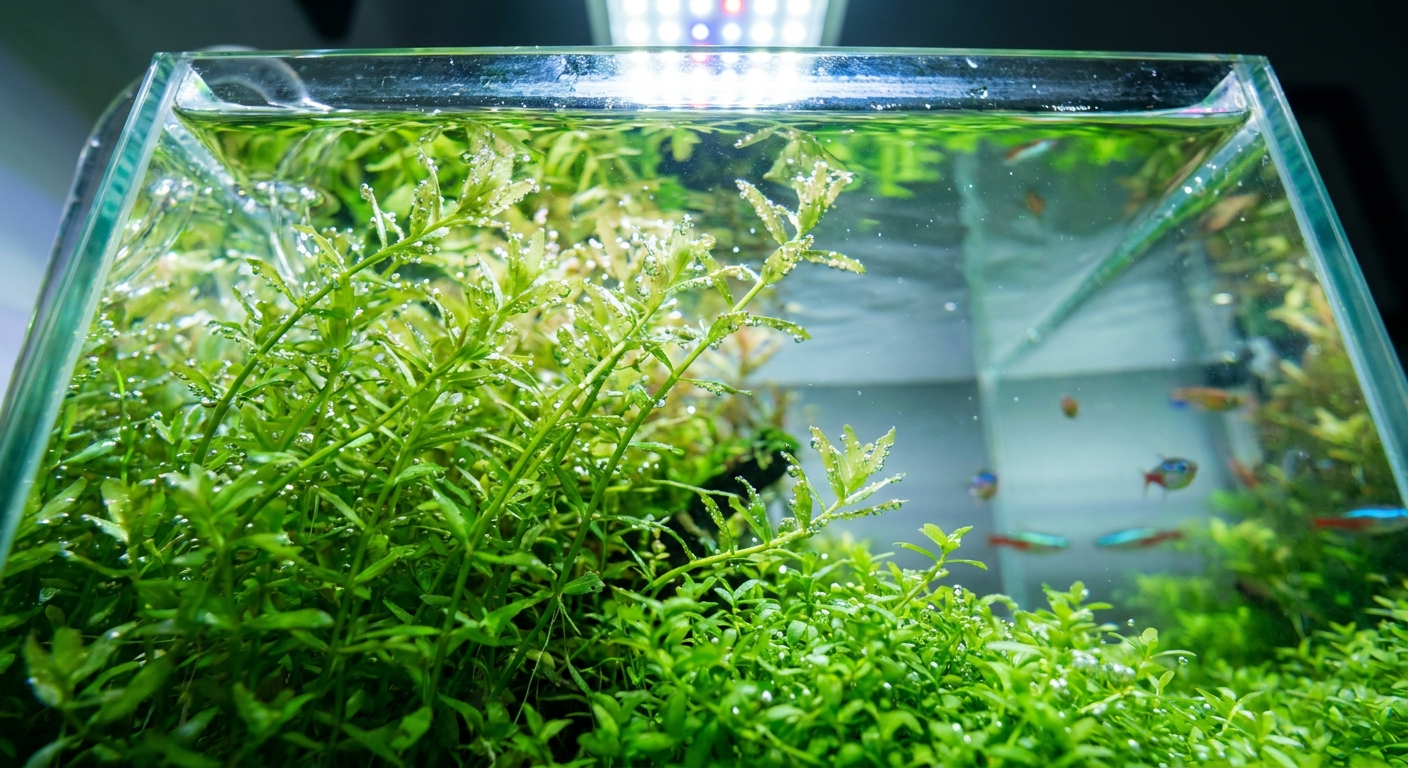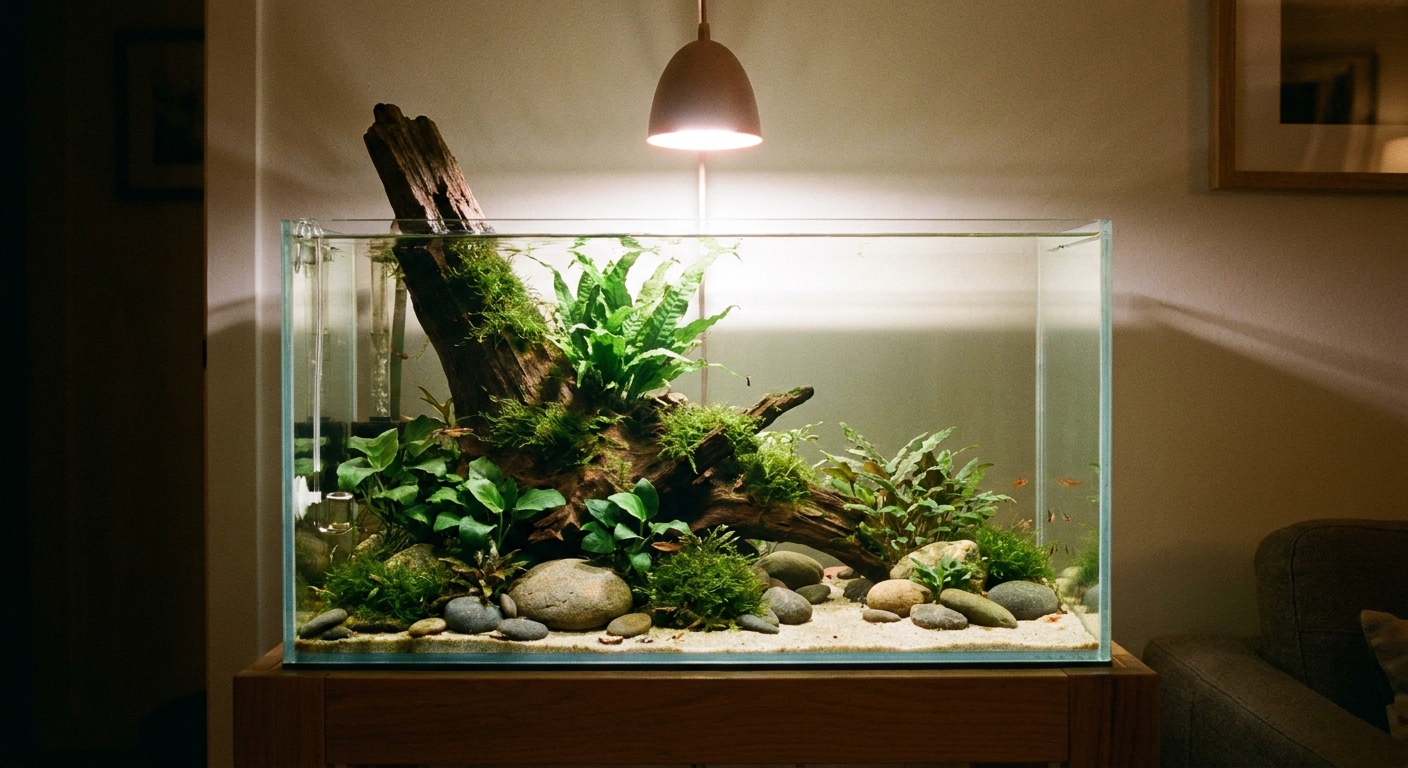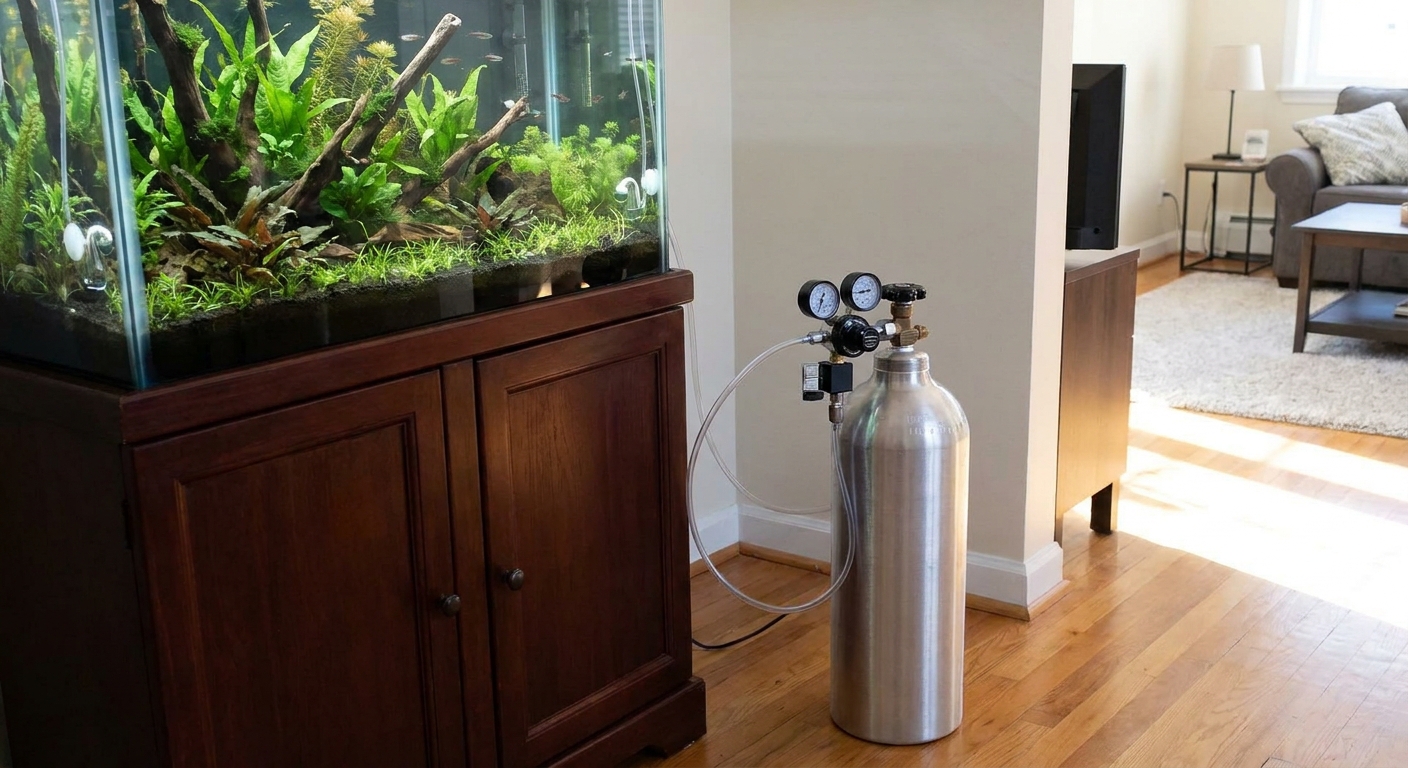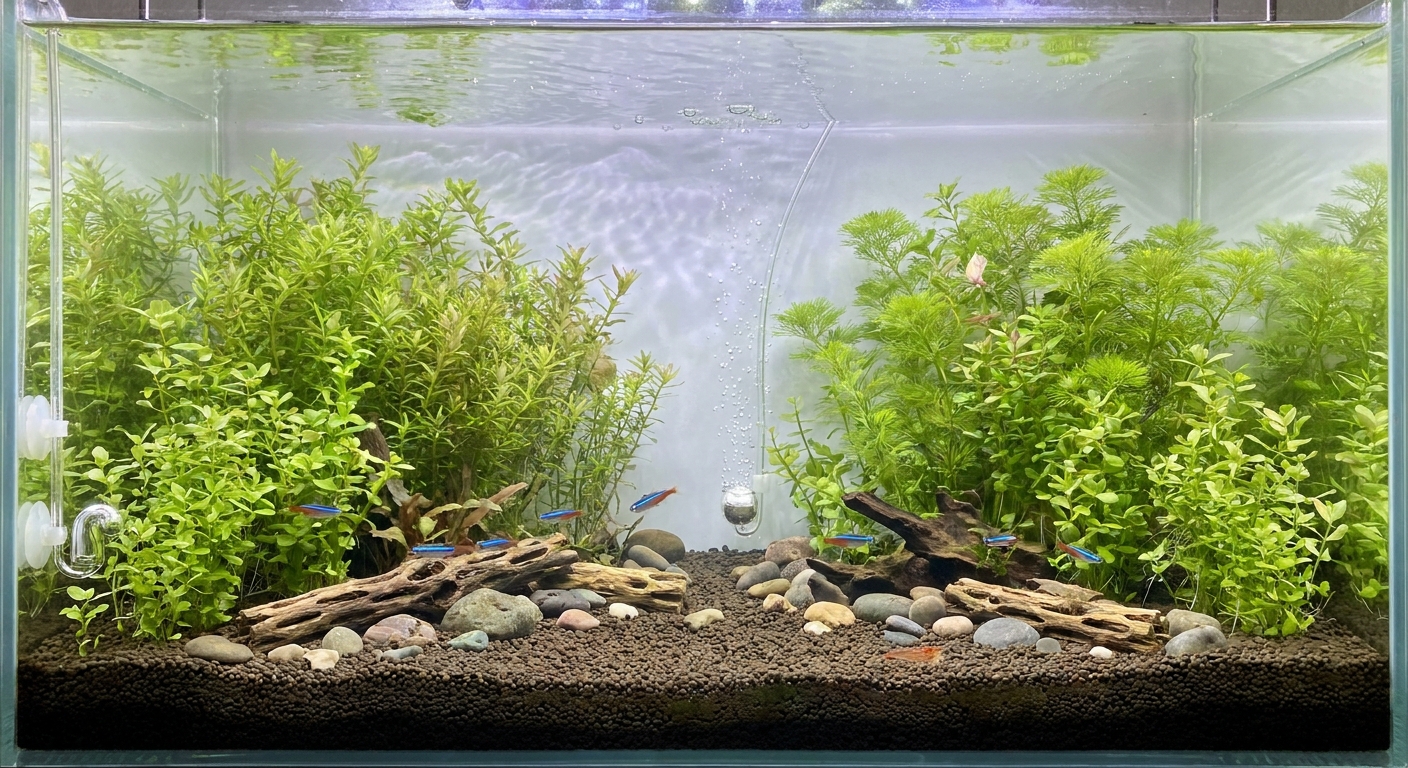
Let’s grow a beautiful underwater jungle together, one tiny leaf at a time! Light is the engine that powers it all, but aquarium lighting labels can feel like they were written for satellites instead of stem plants. With a warm wave of my antennae, here’s how to read what really matters: PAR (the plant-usable light range), intensity (how much of that usable light actually reaches your plants), spectrum (what colors the light contains), and photoperiod (how long you run it).
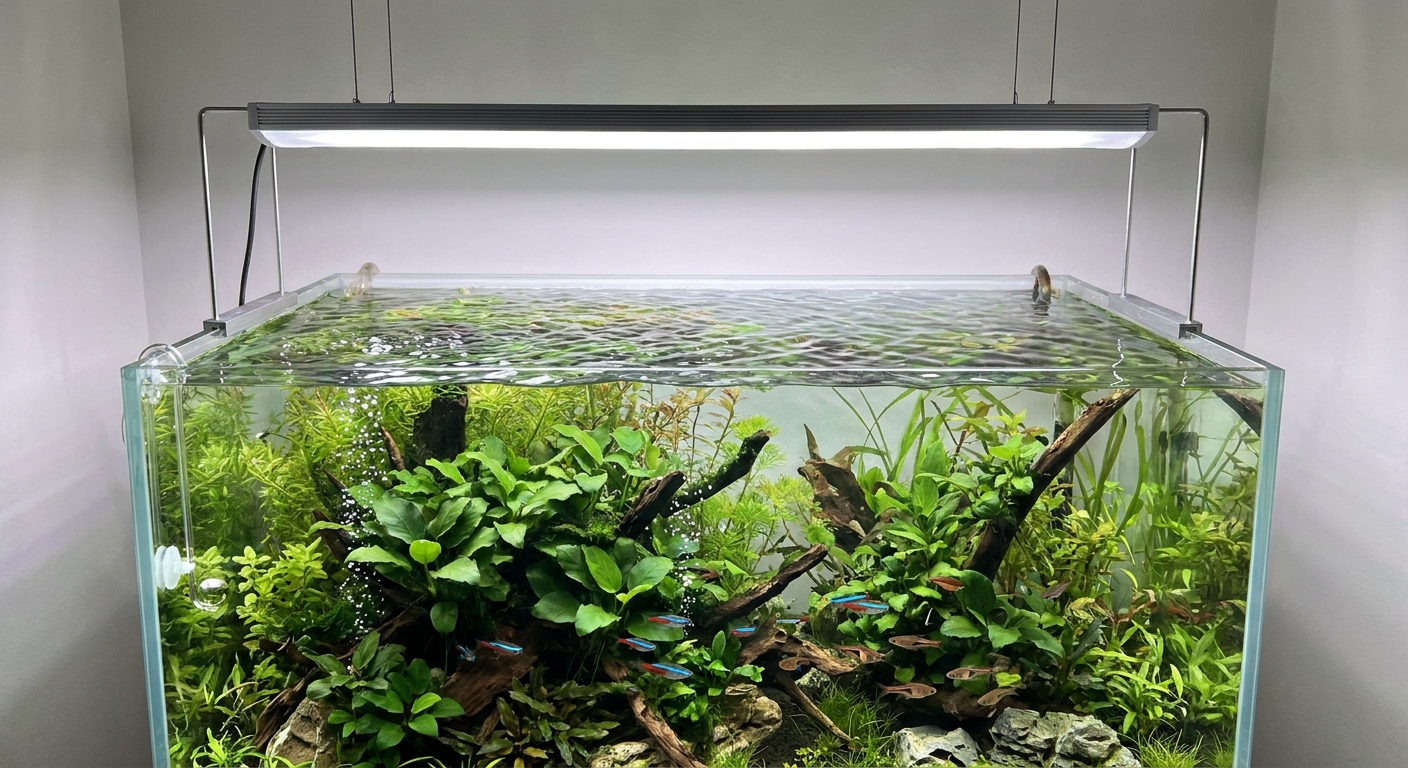
Lighting basics
Aquatic plants don’t care about wattage or how bright a fixture looks to human eyes. They respond to photons in the 400 to 700 nm range, which we call PAR (Photosynthetically Active Radiation). What we usually want to know is how much of that PAR hits the leaves, which is where PPFD comes in.
When light is pushed higher than your tank can support with stable carbon (CO2 or natural) and nutrients, algae can take advantage. That said, algae is rarely just “too much light.” Instability (especially CO2 swings) and excess organics often matter just as much.
So the goal is not “maximum brightness.” The goal is balanced energy: light matched to plant demand and your system’s ability to supply carbon and nutrients.
- Intensity (PPFD) sets your growth potential and how unforgiving the tank can become.
- Spectrum affects plant morphology a bit, but mostly affects how the tank looks to you.
- Photoperiod controls total daily light dose and is one of the easiest algae levers.
Understanding PAR and PPFD
PAR vs PPFD
You will see two common terms:
- PAR: the plant-usable light range (400 to 700 nm). People use “PAR” casually to mean “plant light.”
- PPFD: how many PAR photons hit a surface each second, expressed as µmol/m²/s. This is what you want when comparing light levels at the substrate or midwater.
If a light claims “high PAR,” look for a PPFD number at a specific distance or tank depth. Without distance, the number is not very useful.
Why substrate readings matter
Most planted tanks want healthy growth where plants actually sit: near the substrate for carpets and most rosettes, and midwater for epiphytes and mosses. Water depth, floating plants, surface agitation, tannins, and hardscape shadows all reduce the light that reaches lower leaves.
Shrimp-sized rule of thumb: A tall tank needs more fixture power, better optics, or both to deliver the same PPFD at the bottom as a shallow tank.
Typical PPFD targets
These ranges are meant as a starting point at the plant canopy (often the substrate for carpets). They are not strict lines. Different species, water clarity, reflector design, mounting height, and shading can change your real-world readings. Also, “high light” in a no-CO2 tank can start feeling high well before 60, depending on stability.
| Light level | Approx. PPFD at plants | Good for | Common risks |
|---|---|---|---|
| Low | 10 to 30 µmol/m²/s | Anubias, Java fern, many Cryptocoryne, most mosses | Slow growth, detritus buildup if flow and maintenance are weak |
| Medium | 30 to 60 µmol/m²/s | Most stems, many carpets with patience, stronger coloration with good nutrition | Algae if CO2 and fertilization lag behind |
| High | 60 to 100+ µmol/m²/s | Demanding carpets, dense stem growth, best chance at vivid reds | Algae outbreaks if CO2, flow, and nutrients are not consistent |
If you are running a low-tech tank without CO2, staying in the low to lower-medium range is usually the smoothest path. If you want faster growth or carpets, visit how to grow a dense aquarium carpet and plan your lighting and CO2 strategy together.
How to estimate PPFD
If you want the cleanest answer, a true PAR meter is the gold standard. In everyday hobby life, you can still get close by combining:
- Manufacturer PAR maps (best when they show readings at your tank depth).
- Your own consistent measurement point: check at the substrate and midwater, because a carpet and a Buce shelf live in different worlds.
- A phone lux meter as a personal baseline: lux is not PPFD, but if you keep the same fixture and settings, lux readings can help you repeat a “known good” setup after maintenance or a rescape.
Lux and lumens
Lumens and lux describe brightness as humans perceive it, weighted toward green light. Two fixtures with the same lumens can deliver very different PPFD depending on spectrum and optics. Lux can still be useful for repeatability if you measure your own tank and keep spectrum similar, but it is not a universal “plant light score.”
Spectrum
Spectrum is the mix of wavelengths an LED emits. Plants can use blue, green, and red light for photosynthesis, with blue (around 450 nm) and red (around 660 nm) being especially efficient in leaf chemistry. In many aquariums, green to yellow wavelengths tend to travel deeper than red, although water clarity and depth can change what penetrates best.
Kelvin ratings
Many aquarium lights are sold by color temperature (Kelvin). Kelvin does not directly tell you PPFD, but it does hint at the visual tone:
- 5000K to 7000K: “daylight” white, natural greens, often a good all-around planted look.
- 7000K to 9000K: crisp white, slightly cooler, can make greens pop and water look bright.
- Very cool 10000K+: icy tone, can look marine-like in freshwater unless balanced with warmer channels.
If a fixture includes adjustable channels, you can tune for your eyes while keeping intensity appropriate for your plants.
Do red and blue channels matter?
Modern white LEDs already include plenty of usable wavelengths for plant growth. Dedicated red and blue channels can help with:
- Color rendering, especially bringing out red plants and warm-toned fish
- Fine tuning if you like a warmer or cooler overall look
But spectrum is rarely the main reason plants struggle. When growth stalls or algae takes off, the usual culprits are too much intensity, inconsistent CO2, or imbalanced nutrients. For red plants in particular, see how to make aquarium plants red, because light is only one piece of that puzzle.
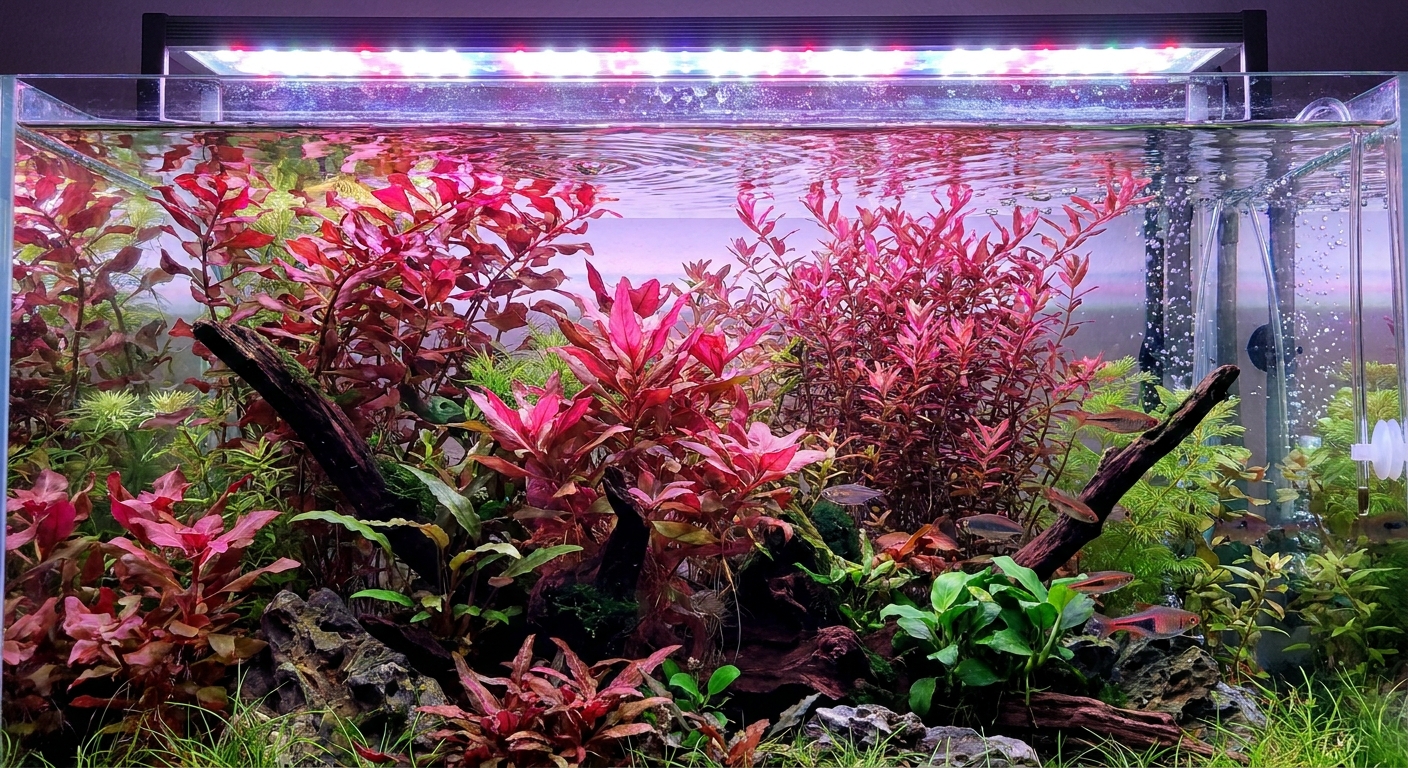
Photoperiod
Photoperiod is simply how long the lights are on each day. It shapes your tank’s daily light dose. Even moderate PPFD can become “too much” if you run it for a very long time.
If you want a name for that daily dose, it is often called DLI (Daily Light Integral). In plain words, DLI is intensity over time. If you keep PPFD the same but run the lights longer, the total dose goes up.
Good starting schedules
- Newly planted or recently rescaped tanks: 6 hours/day is a calm starting point.
- Stable low to medium light tanks: 7 to 8 hours/day is common.
- High light and CO2 injected tanks: 7 to 8 hours/day often works better than longer runs.
If algae appears, the most shrimp-friendly first move is often reducing photoperiod by 30 to 60 minutes and holding it steady for 1 to 2 weeks while keeping maintenance consistent.
Split photoperiods
Some aquarists split lighting into two blocks with a break in the middle. Results vary. A split schedule can be useful if it helps you enjoy the tank during waking hours, but it is not a guaranteed algae fix. Plants can adapt to a stable routine, so the best schedule is usually the one you can keep consistent.
Choosing an LED fixture
When comparing LED lights for planted tanks, these are the specs that tend to matter most.
1) PPFD info at depth
Best case is a PAR map or PPFD readings at multiple points. Look for measurements that match your tank depth. If you only see “PAR 200,” but no distance, treat it as marketing fog.
2) Dimming control
Dimming is your safety net. It lets you start lower, observe plant response, and increase intensity slowly. For many aquascapes, the sweet spot is a fixture with headroom plus a dimmer: strong enough to reach your target PPFD, but easy to back down while the tank settles.
3) Coverage and spread
A fixture should cover the full tank footprint. Narrow beams can create hot spots and shaded corners. Spread matters for carpets and for preventing tall stems from stealing all the light.
4) Mounting height and optics
Raising a light increases spread but reduces intensity at the substrate. Lowering increases intensity but can create uneven lighting. If your hardscape creates deep caves and overhangs, even lighting becomes more important.
5) Timer reliability
Plants love consistency. Whether it is an integrated timer or an external one, a dependable on and off schedule reduces daily swings that can stress plants and invite algae.
Match light to demand
Here’s a simple way to align your lighting choice with the kind of planted tank you want to keep.
Low demand setups
- Light: low to medium intensity
- Photoperiod: 7 to 8 hours
- Plants: Anubias, Java fern, Bucephalandra, many Crypts, mosses
If you love epiphytes on wood and rock, flow and cleanliness matter as much as light. For Buce, see Bucephalandra care: light, flow, and algae control.
Medium demand community tanks
- Light: medium intensity with dimming
- Photoperiod: 7 hours, adjust to 8 if algae stays calm
- Plants: most stems, many background plants, easier carpets with patience
This is also where fast growers can help you stabilize early. If you are cycling a fresh tank, check fast-growing stem plants that beat algae in new tanks.
High demand aquascapes
- Light: high intensity, but only if CO2 is stable
- Photoperiod: usually 7 to 8 hours, not 10 to 12
- Plants: demanding carpets, compact stems, vibrant reds
In high light, small inconsistencies show up fast. If algae appears, avoid the temptation to crank brightness higher. Dial in CO2 stability, circulation, and a steady routine first.
Dial in your lighting
- Pick a starting photoperiod: 6 to 7 hours if the tank is new, 7 to 8 hours if it is stable.
- Start at a conservative intensity: if the light is dimmable, begin around 40 to 60% rather than 100%.
- Watch plant signals for 2 weeks: focus on healthy new growth, steadier algae levels, and overall plant posture. Pearling can sometimes be a fun sign of strong photosynthesis, but it is not the only health check.
- Increase slowly if needed: adjust intensity up 5 to 10% at a time, or add 30 minutes to photoperiod, not both at once.
- If algae rises: reduce photoperiod first, then intensity, and improve maintenance and flow.
Maintenance habits matter because algae feeds on leftover organics and instability. If the tank feels like it is constantly drifting out of balance, the troubleshooting path is waiting at Maintenance & Troubleshooting.
Common mistakes
Running the light too long
Symptom: algae slowly builds even though plants look okay.
Fix: reduce photoperiod by 30 to 60 minutes, keep it steady for 1 to 2 weeks.
Turning intensity up to beat algae
Symptom: more algae, not less, and plants look stressed or stunted.
Fix: lower intensity and prioritize CO2 consistency, circulation, and nutrient balance.
Ignoring shading and placement
Symptom: healthy tops, melting bottoms, or bare stems under dense canopies.
Fix: trim and replant stems, thin floating plants, and consider raising the fixture for better spread.
Buying by watts
Symptom: disappointment when a “powerful” watt rating does not translate to good growth.
Fix: look for PPFD at depth, coverage, and dimming instead of wattage alone.
FAQ
How many hours of light do planted tanks need?
Most planted tanks thrive around 7 to 8 hours/day. New or algae-prone tanks often do better starting at 6 hours/day and increasing slowly.
What PAR is best for beginner planted tanks?
For beginners, a comfortable target is often low to medium PPFD at the plant level, roughly 10 to 40 µmol/m²/s depending on species. Lower intensity reduces algae pressure and increases the margin for error.
Does spectrum matter more than intensity?
For plant health, PPFD intensity and consistency usually matter more. Spectrum affects aesthetics and can influence growth form a bit, but a good white planted LED can grow plants beautifully when intensity and photoperiod are appropriate.
Can you have too much light with no CO2?
Yes. In low-tech tanks, very bright light can outpace natural carbon availability, and algae often takes advantage, especially when the tank is young or maintenance is inconsistent. If you are not injecting CO2, aim for lower intensity and a reasonable photoperiod. The low-tech approach is covered here: Low-tech planted tank design without CO2.
A final shrimp-sized reminder
The best planted tank lighting is not the brightest or most expensive. It is the one you can control and keep consistent. Aim for the right PPFD at the leaves, choose a spectrum you love looking at, and set a photoperiod that supports plants without overfeeding algae. Then enjoy those tiny oxygen bubbles rising like happy tank confetti.