Let’s grow a beautiful underwater jungle together, one tiny leaf at a time. Nano tanks are small, sparkly worlds where every pebble matters, and the trick is keeping everything in scale so your layout looks intentional instead of crowded.
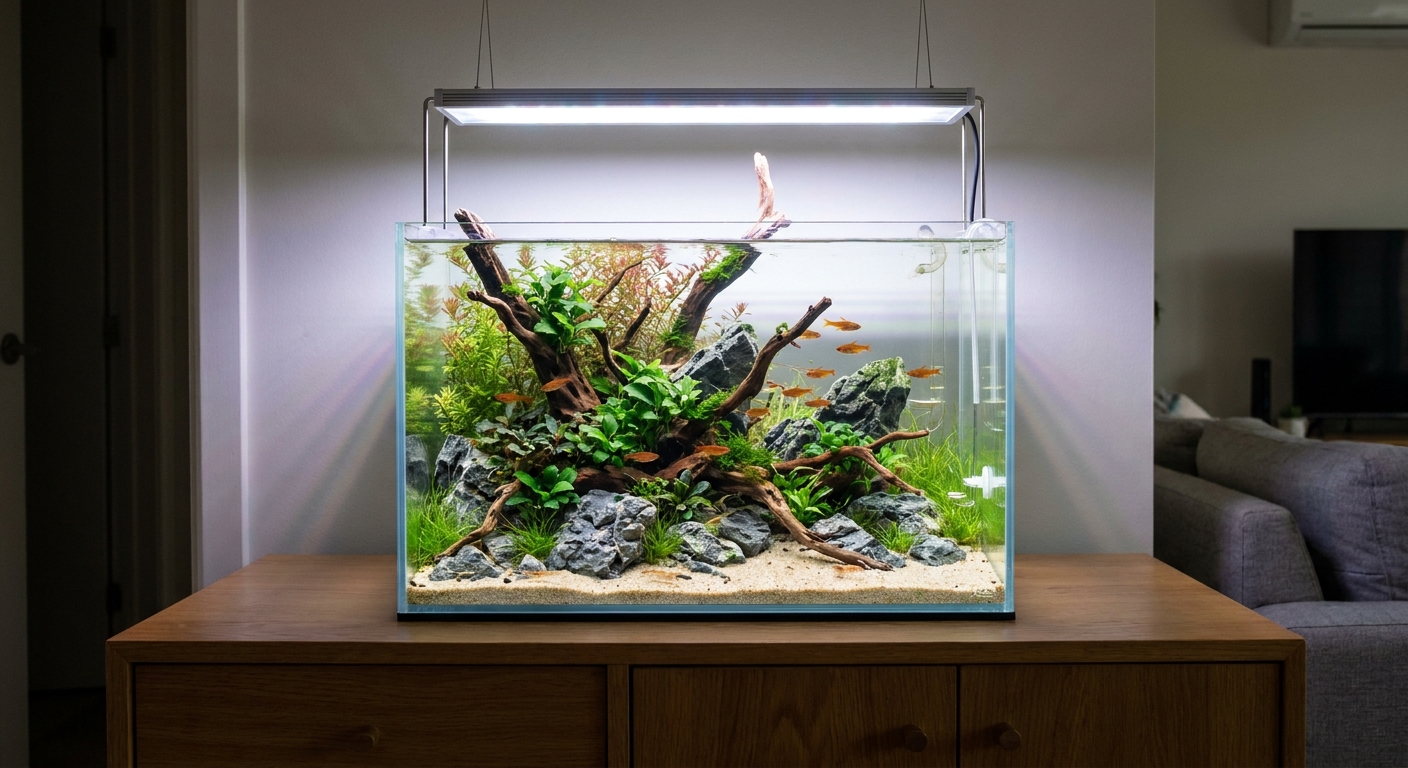
What makes nano aquascaping different
In a 5 or 10-gallon aquarium, the same design choices that look “normal” in a 20 to 60-gallon can feel oversized fast. Nano scapes look their best when you design for scale, negative space, and clean lines.
- Scale: Choose smaller stones, thinner wood, and plants with tiny leaves.
- Negative space: Leave open substrate or open water areas on purpose. It makes the scape feel larger.
- Simple shapes: One main idea wins. Too many features turns into visual noise.
- Stable structure: Small tanks show every shift and sag. Hardscape needs to be locked in.
If you want help placing your “main moment” (the spot your eyes land first), the focal-point principles in Golden Ratio Focal Points in Aquascaping translate beautifully to nanos.
Micro-hardscape strategies
Pick one hero piece
Choose a single main stone or a single main wood branch as the hero. Everything else should look like it belongs to that piece: smaller, quieter, and angled to point attention back toward it.
- 5-gallon: One hero stone or one thin branch is usually enough.
- 10-gallon: One hero plus 2 to 5 supporting pieces tends to feel balanced.
Use nano-grade stone and wood
Hardscape looks most natural when the grain of detail matches the tank size. For nanos, favor:
- Stones with fine texture: Smaller pores, tighter patterning, fewer huge craters.
- Thinner driftwood: Branchy pieces read like trees. Thick chunks can feel like logs that swallow the tank.
Build depth with size and height
To make a small tank feel deep, try these tiny-perspective tricks:
- Smallest stones in the back: Larger stones in front, smaller behind creates forced perspective.
- Substrate slope: Low front, higher back. Even 2 to 3 cm of rise helps.
- Keep the front glass clean: Leave a thin open sand strip or open foreground on purpose.
Stabilize hardscape safely
Nano tanks get bumped during maintenance, and even a small rock slide looks dramatic through tiny glass walls.
- For best stability, seat stones on a firm base so they cannot settle later. Many aquascapers place hardscape on the tank bottom with full contact, or on a thin protective layer (like a hardscape base plate or light diffuser grid) to reduce point pressure from sharp edges.
- Wedge supporting stones so the main stone cannot roll forward.
- Use hardscape-safe aquarium glue only when needed, especially for vertical branch structures.
Best 5-gallon layouts
In 5 gallons, the most successful layouts are the ones with one clear composition and plants that stay small. Here are dependable styles that keep scale.
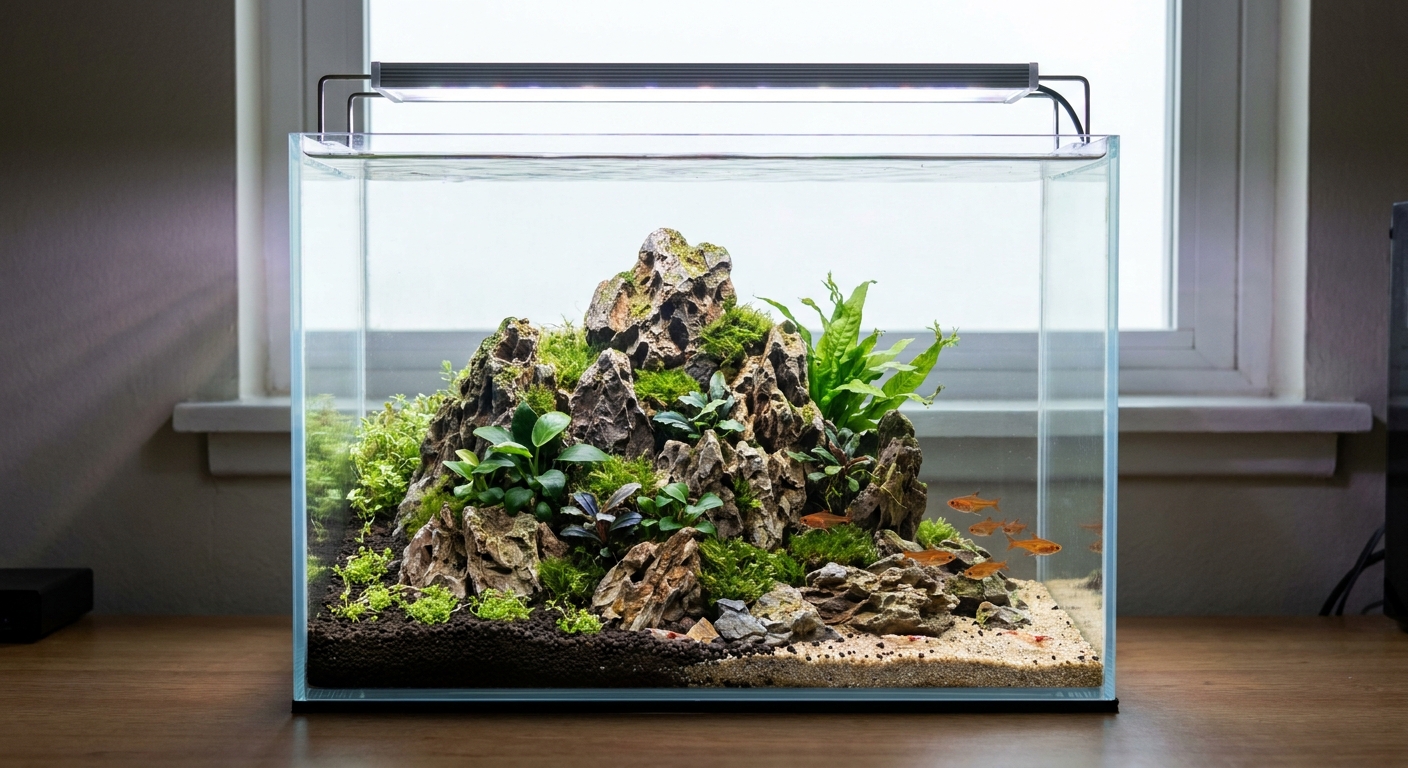
1) Mini island
A single island hardscape placed slightly off-center, surrounded by open substrate.
- Hardscape: One main stone or wood cluster, plus 2 to 4 tiny supporting pieces.
- Planting idea: Moss or epiphytes on the island, a low carpet around it, and a very small background plant behind.
- Why it works: The open space makes the tank feel bigger.
2) Nano triangle
A strong slope from one side high to the other side low, like a little hillside.
- Hardscape: Stones stepping down in size from the high side to the low side.
- Planting idea: Taller, fine-leaf plants on the high side, carpet or short plants on the low side.
- Why it works: Depth looks natural even in a short tank.
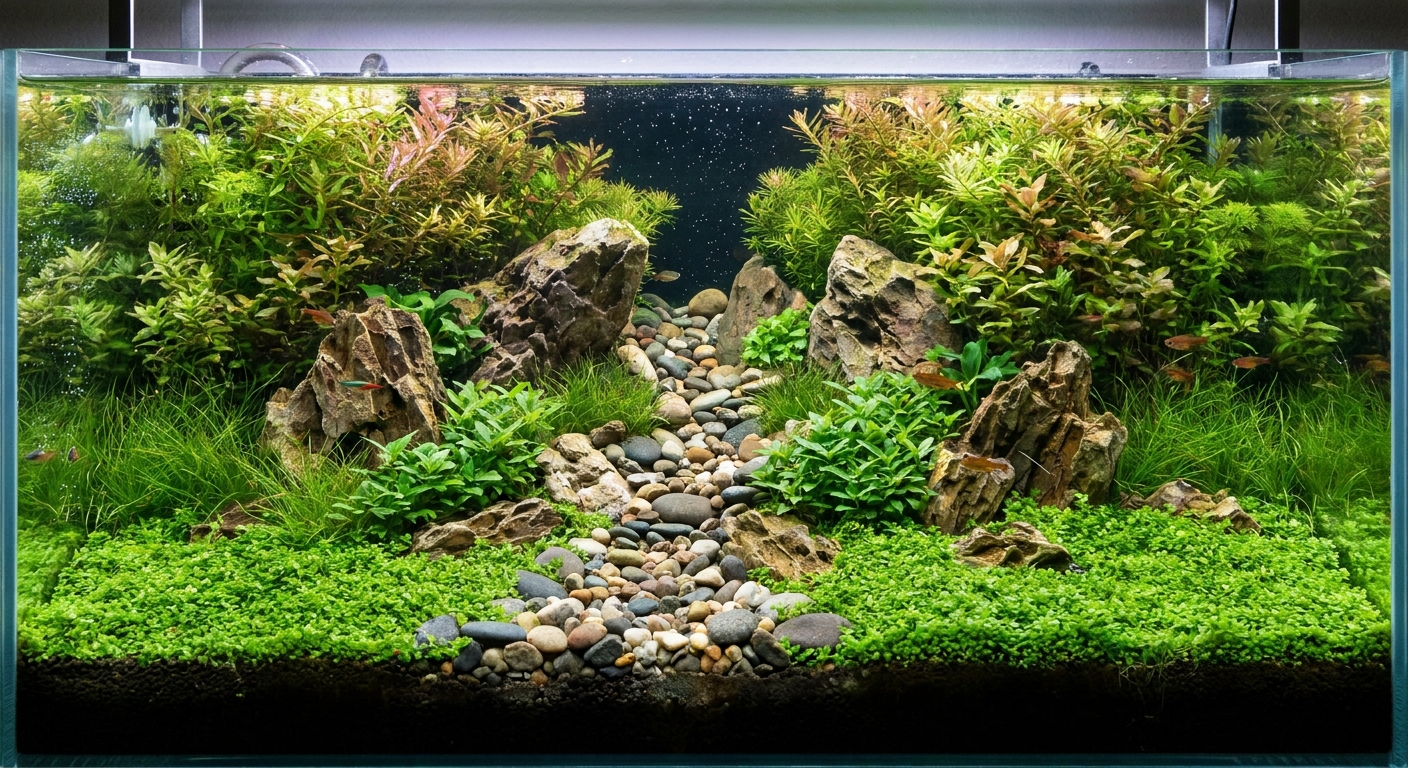
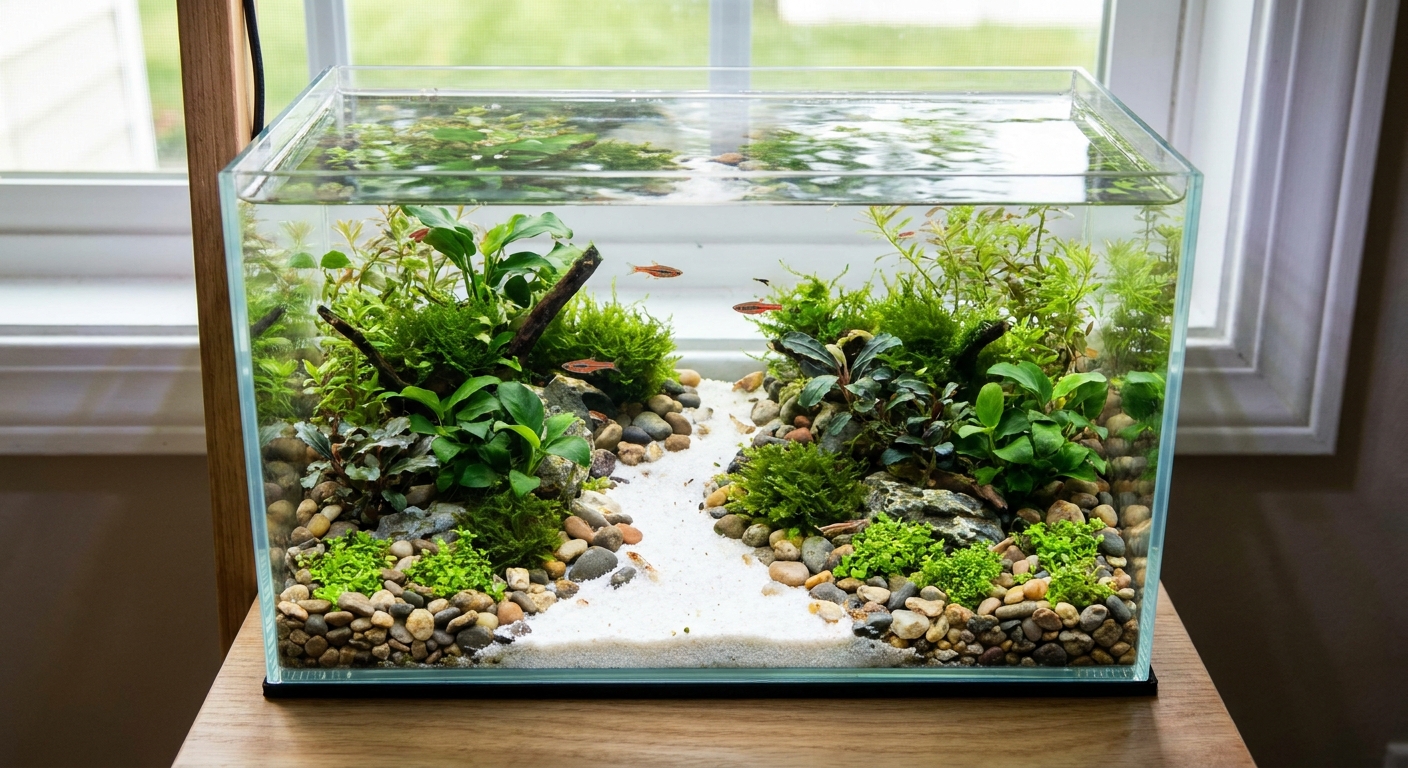
3) Mini canyon path
A narrow open path of sand or fine gravel leading toward the back, with hardscape on both sides.
- Hardscape: Two small ridges facing each other, not touching the glass.
- Planting idea: Tiny foreground around the path edges, moss on stones, short background stems.
- Why it works: The path pulls your eye inward and adds perspective.
Best 10-gallon layouts
Ten gallons gives you more breathing room, which means you can add a second layer of detail, as long as the composition stays simple.
1) Two-island balance
Two separate hardscape clusters, one dominant and one smaller, with open space between them.
- Hardscape: One main island and a smaller echo island.
- Planting idea: Keep the smaller island less planted so it stays visually lighter.
- Why it works: It creates rhythm without feeling busy.
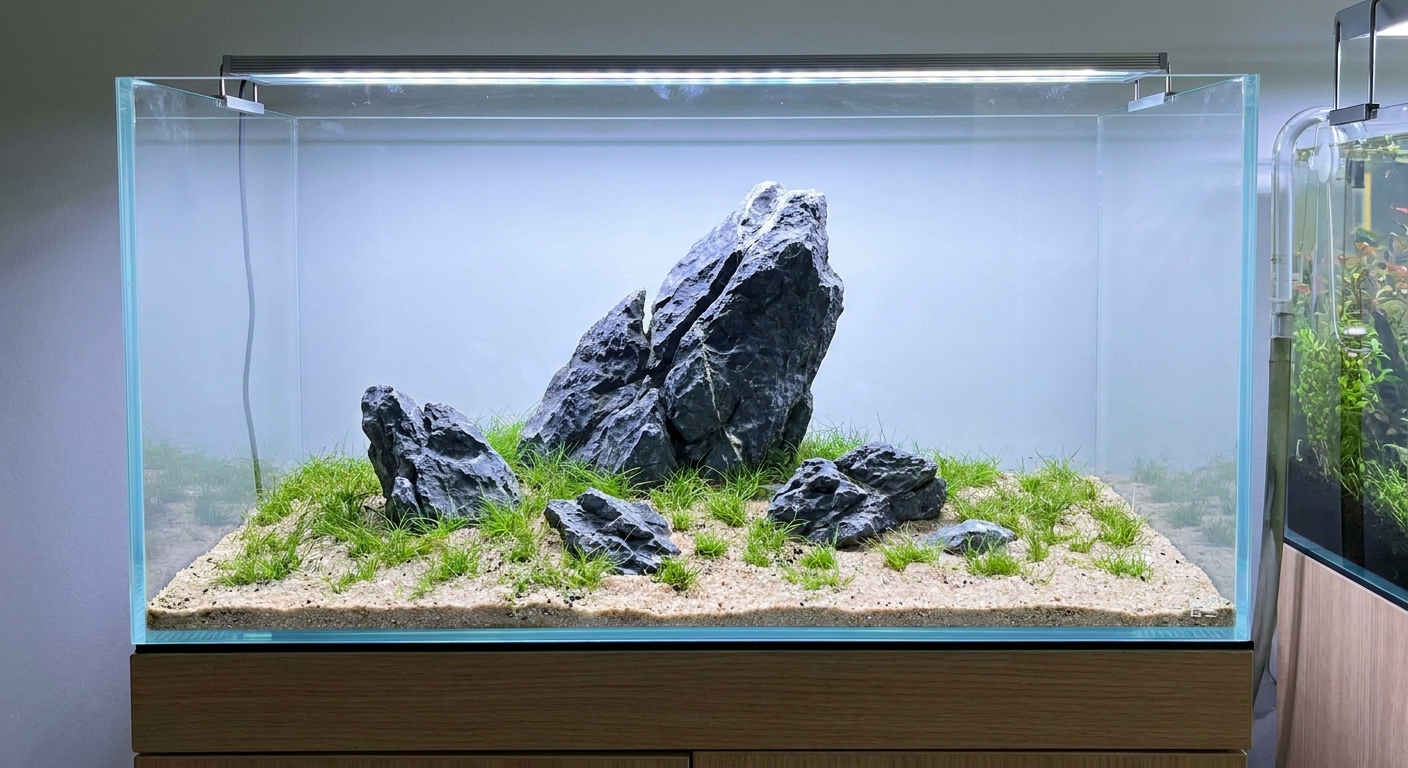
2) Low iwagumi
A clean stone-focused layout with low planting. This can look stunning in 10 gallons if the stones are scaled down carefully.
- Hardscape: One main stone with 3 to 7 supporting stones, aligned to feel like one geology story.
- Planting idea: A tight, low carpet and minimal accents.
- Why it works: The simplicity reads as intentional and calm.
If you love this style, follow the structure guidance in Iwagumi Aquascape Step-by-Step for Beginners and just scale the materials down for a 10-gallon footprint.
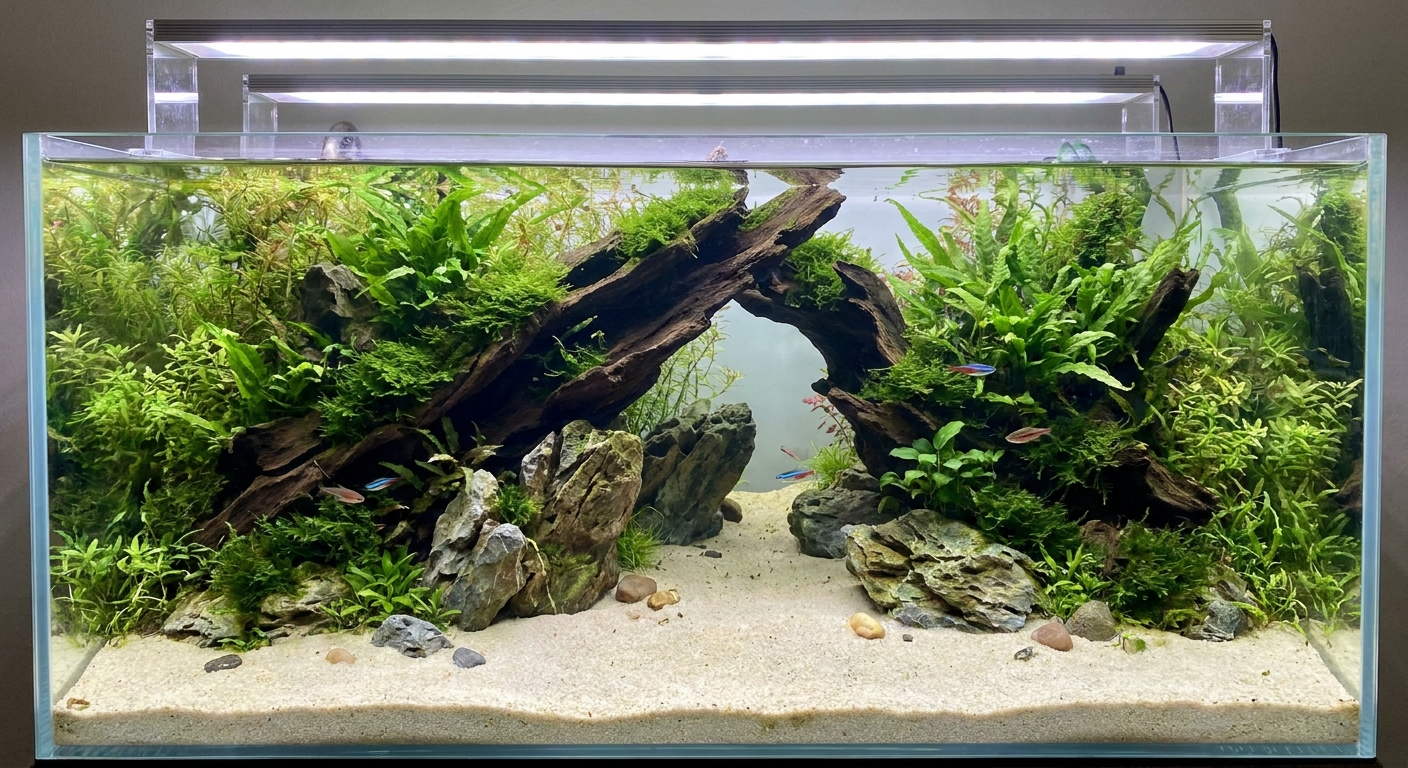
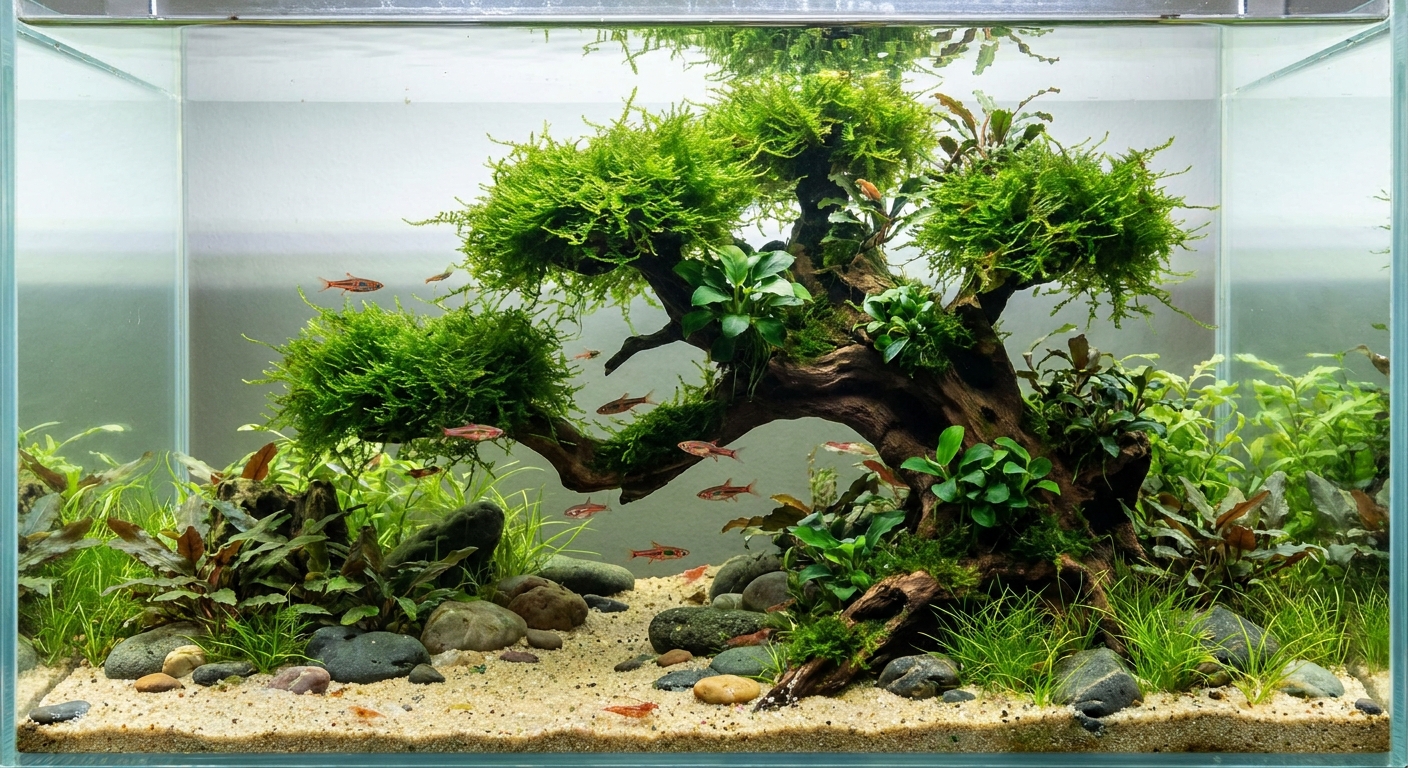
3) Branch tree with epiphytes
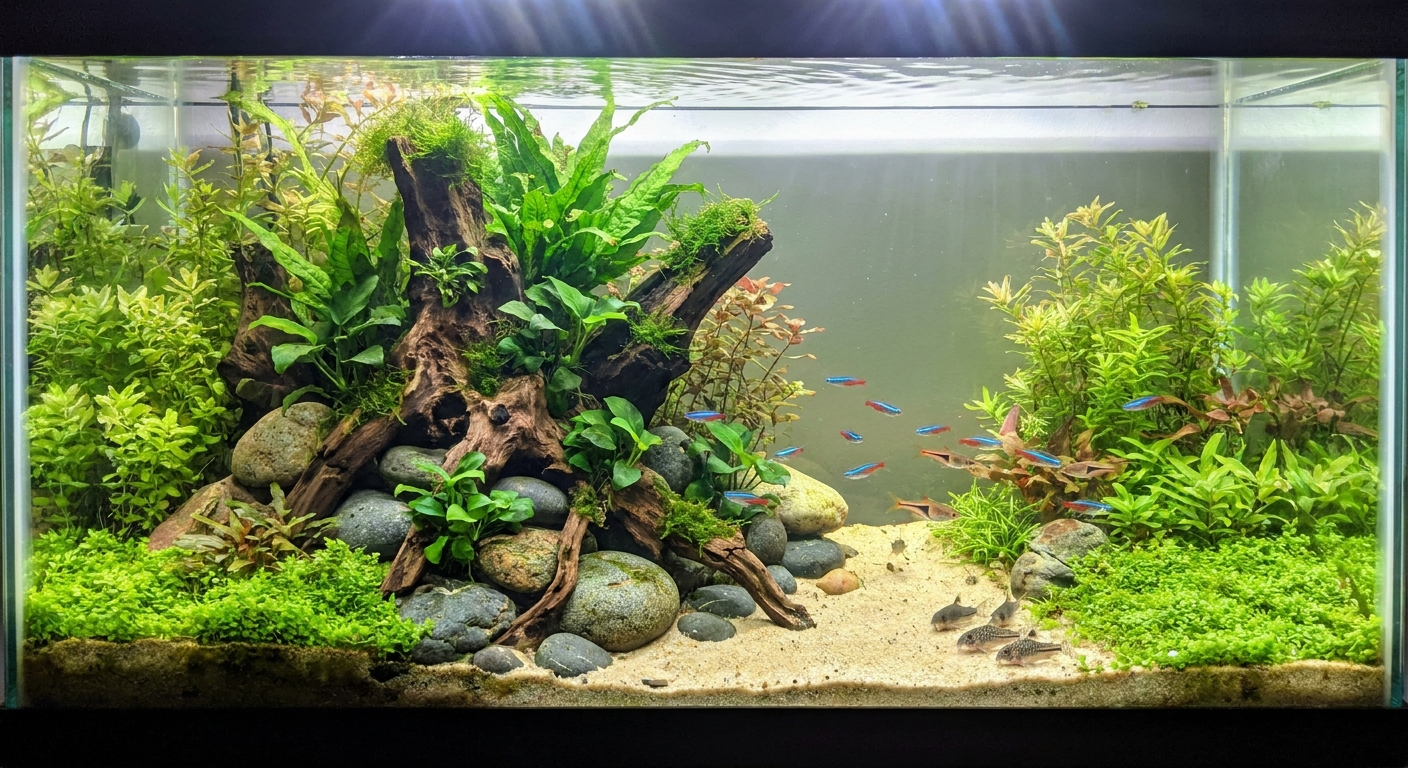
A single branchy wood piece becomes the tree, planted with tiny epiphytes and moss to form a canopy.
- Hardscape: One main branch with a few thinner offshoots.
- Planting idea: Epiphytes on the branches, carpet below, and a small background plant to frame the silhouette.
- Why it works: The vertical shape adds drama without needing lots of extra pieces.
Plants that stay in scale
Nano plant picks should be chosen for leaf size, growth speed, and how often they need trimming. Fast growers can look amazing, but in a small tank they can also erase your layout in a week if you do not keep up.
Foreground and carpets
- Micranthemum tweediei ‘Monte Carlo’: Round leaves that look naturally small in 5 and 10 gallons.
- Hemianthus callitrichoides (dwarf baby tears): Ultra tiny leaves and beautiful scale. It can be grown without CO2 in some setups, but a tight, reliable carpet is much easier with stable CO2 and strong light.
- Mini hairgrass: Often sold as “mini hairgrass” (species naming varies by seller, commonly listed as Eleocharis acicularis ‘Mini’ or Eleocharis parvula).
- Marsilea hirsuta or crenata: Slow, tidy groundcover look that fits nano proportions.
Midground
- Anubias nana ‘petite’: Tiny, durable leaves for attaching to stones and wood.
- Bucephalandra mini varieties: Great for detail work on hardscape with interesting leaf tones.
- Cryptocoryne parva: Small crypt that can form low clusters over time.
- Staurogyne repens: A compact bushy look, especially when trimmed low.
Background in nanos
- Rotala rotundifolia: Works well if trimmed often and kept airy, not allowed to turn into a dense wall.
- Rotala ‘H’ra’: A trade-name rotala (also sold as Rotala sp. ‘H’ra’ or ‘Gia Lai’) that can add color in 10 gallons without huge leaves.
- Limnophila sessiliflora: Feathery texture, but can grow quickly and needs frequent trims.
Moss and micro-epiphytes
- Christmas moss or weeping moss: Great for softening stone edges and making wood look ancient.
- Riccardia (mini pellia): Tight texture that looks like tiny coral, perfect at nano scale.
- Fissidens: Fine fronds that read beautifully in small tanks.
For more plant-by-plant browsing, swim through Aquatic Plants.
Nano stability basics
Nano tanks are adorable, and also a little dramatic. In small volumes, changes happen faster: temperature swings show up sooner, evaporation shifts concentration, and dosing can go from “helpful” to “whoops” in a blink.
- Evaporation: Top off consistently to keep water level and concentration stable. In a tiny tank, an inch of drop is not subtle.
- Water changes: A simple starting point is smaller, more frequent changes rather than big, occasional ones. It keeps the tank feeling crisp.
- Flow and filtration: Gentle, even flow helps keep debris from settling in corners without blasting your carpet. Sponge filters and small HOBs can both work if adjusted for soft flow.
- Heat: Some rooms stay stable without a heater, others do not. If your space swings, a small adjustable heater can save a nano from daily temperature stress.
- Fertilizers: Start low and increase slowly. In nanos, it is easier to overdose than it is to underdose.
If you are building your first setup, the basics in Equipment Setup can help you choose a simple, stable starting kit.
Rules that prevent clutter
Limit your plant palette
In nanos, 3 to 6 plant types often looks more natural than 12. Too many leaf shapes makes the tank feel messy.
Repeat one texture
Repeating a single plant in a few spots (like the same epiphyte on multiple stones) creates unity and makes the scape feel larger.
Keep hardscape off the glass
Leave a small gap behind and along the sides when possible. It can improve circulation, makes cleaning easier, and can reduce the chance of problem spots where debris collects.
Use thin layers
Instead of stacking lots of stones and wood, build one clean structure and let plants add the lushness. Nano tanks look best when the hardscape reads clearly from across the room.
Easy nano recipes
5-gallon mini island
- Hardscape: 1 hero stone + 3 supporting stones
- Foreground: Monte Carlo or Marsilea
- Midground: Anubias nana ‘petite’ on the stone
- Detail: Small patches of moss in cracks
- Background: A light trim line of Rotala in one back corner
10-gallon low iwagumi
- Hardscape: 1 main stone + 5 to 9 smaller stones
- Foreground: Mini hairgrass or a tight carpet of Monte Carlo
- Accent: A few small epiphytes tucked behind stones (keep it subtle)
10-gallon branch tree
- Hardscape: 1 branchy driftwood tree + a few pebble supports
- Canopy: Moss and Bucephalandra on branches
- Base: Marsilea or a low carpet around the trunk
- Frame: A small background group of fine stems behind the tree
Keeping scale over time
Nano aquascapes do not fail because the idea was bad. They usually drift out of scale as plants grow. The solution is simple: trim with the original silhouette in mind.
- Trim early: A light weekly trim is easier than a major rescue cut.
- Replant tops thoughtfully: Replant stems where they strengthen your slope or your focal area, not everywhere.
- Clean gently: Nano substrates can get stirred easily. Keep the foreground crisp so the layout stays sharp.
- Watch algae on slow growers: Epiphytes and mosses are detail plants. Keep light, nutrients, and flow balanced so they stay fresh.
If something goes wobbly, the fix is often small and quick. The guides in Maintenance & Troubleshooting can help you get the sparkle back without tearing the whole scape down.
Nano livestock note
Many nano scapes are built as plant-first little worlds, and livestock is the gentle supporting cast. Shrimp and small snails are popular because they fit the scale and bioload. With fish, be extra cautious in 5 gallons. It is easier to overstock, and water quality can swing faster than you expect.
Nano tank FAQ
Is 5 gallons too small for aquascaping?
Not at all. It just rewards simpler compositions and smaller materials. Think mini scene instead of full landscape.
What is the biggest mistake in nano aquascapes?
Oversized hardscape and too many plant types. If the stones look like boulders and the leaves look huge, the tank loses its sense of place.
Do nano layouts need CO2?
CO2 is optional. Many nano scapes can look wonderful without it, especially with slow growers like Anubias nana ‘petite’, Bucephalandra, Crypt parva, and mosses. High-demand carpets and very tight lawn looks are easier with CO2 and stable lighting.
How do you make a nano tank look deeper?
Use a substrate slope, put larger elements in front and smaller ones behind, and include a clear negative-space area like a sand path or open foreground strip.
A tiny closing wave from Sprout
Nano tanks are like little glass terrariums filled with water, and when the scale clicks, the whole scene feels alive. Keep one strong idea, pick micro-sized hardscape, choose plants with tiny leaves, and let open space do some of the work. Then protect the silhouette with small, steady maintenance so your mini world stays a mini world.
For more layout inspiration, swim over to Aquascaping Design.