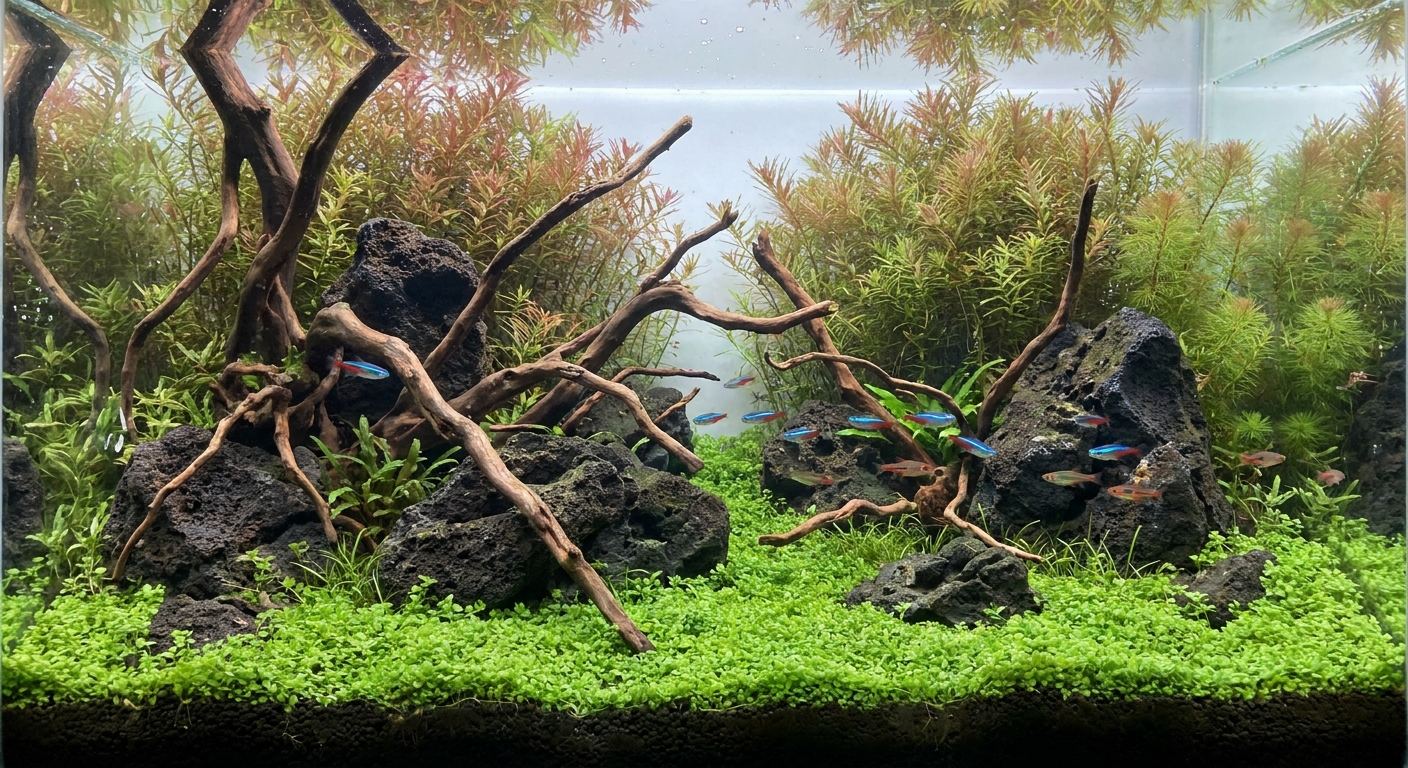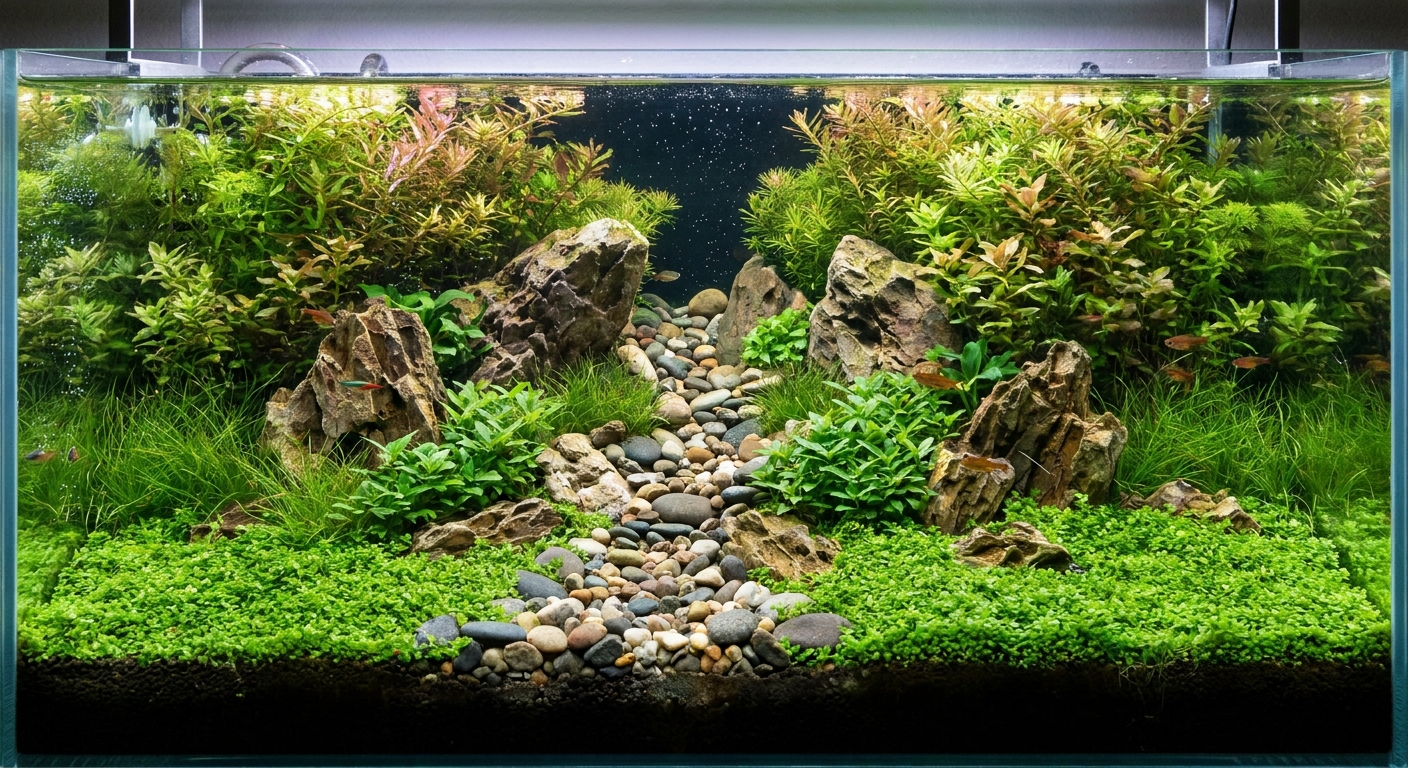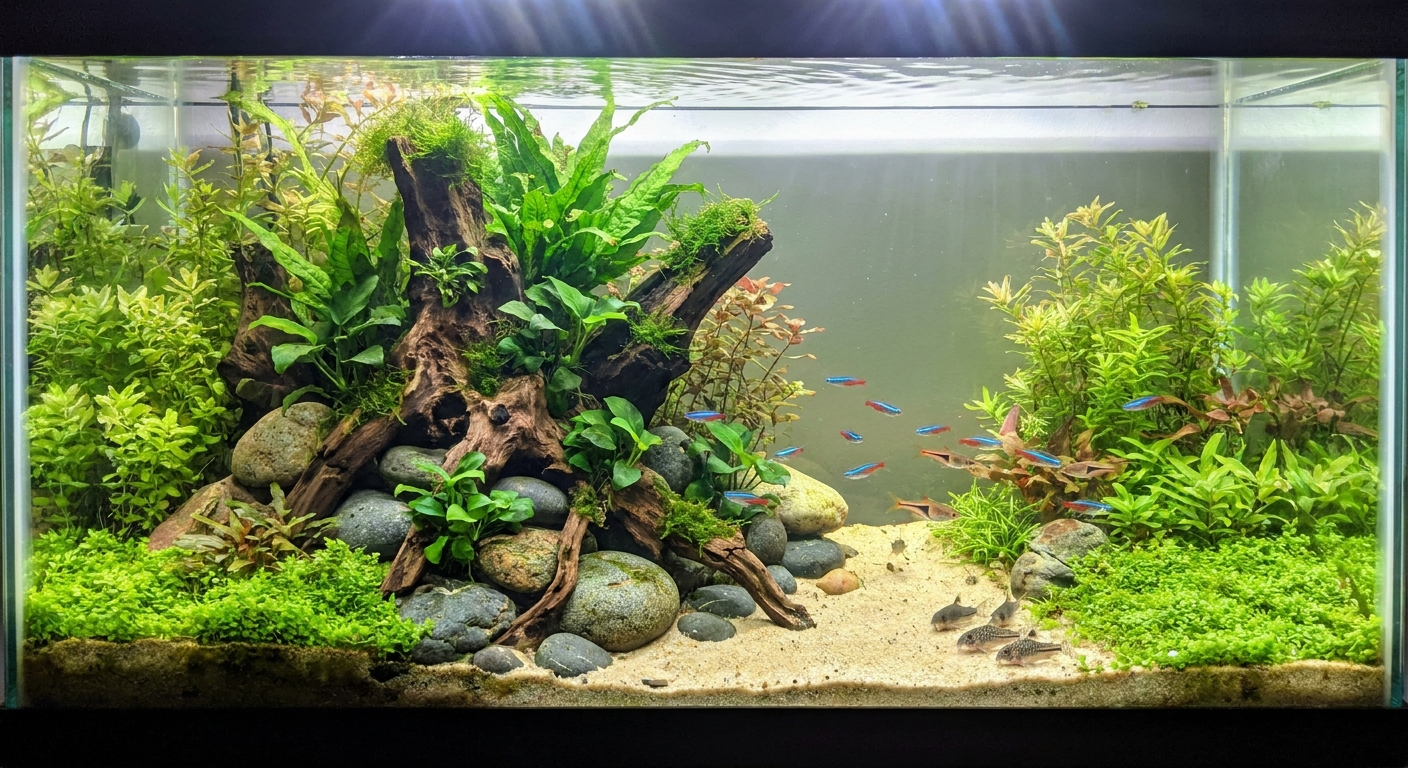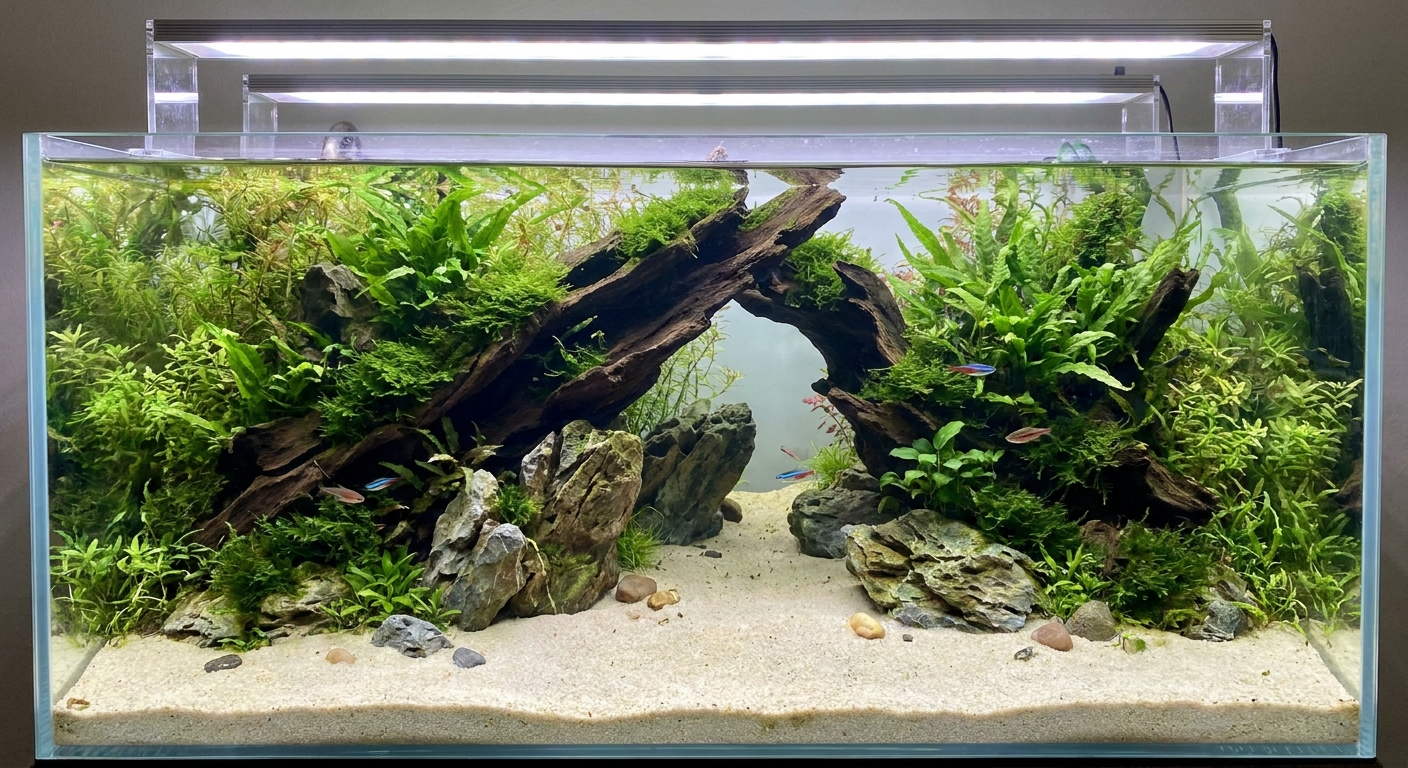
Let’s grow a lush Amazon river scene together, one drifting leaf at a time. An Amazon biotope aquascape is not just “plants plus tannins.” It’s a whole mood: warm, soft water, tannin-tinted water filtering the light into a tea-colored glow, tangled roots, sandy edges, and quiet pockets where fish feel safe.
One quick, important note before we start: “Amazon biotope” can mean two different goals. A strict biotope aims for a specific locality with region-correct plants, wood, leaf litter, and livestock. An Amazon-inspired scape keeps the same look and feel, but may include a few “close enough” plants for practicality. I’ll flag the difference as we go so you can choose your own level of botanical honesty.
What makes it feel real
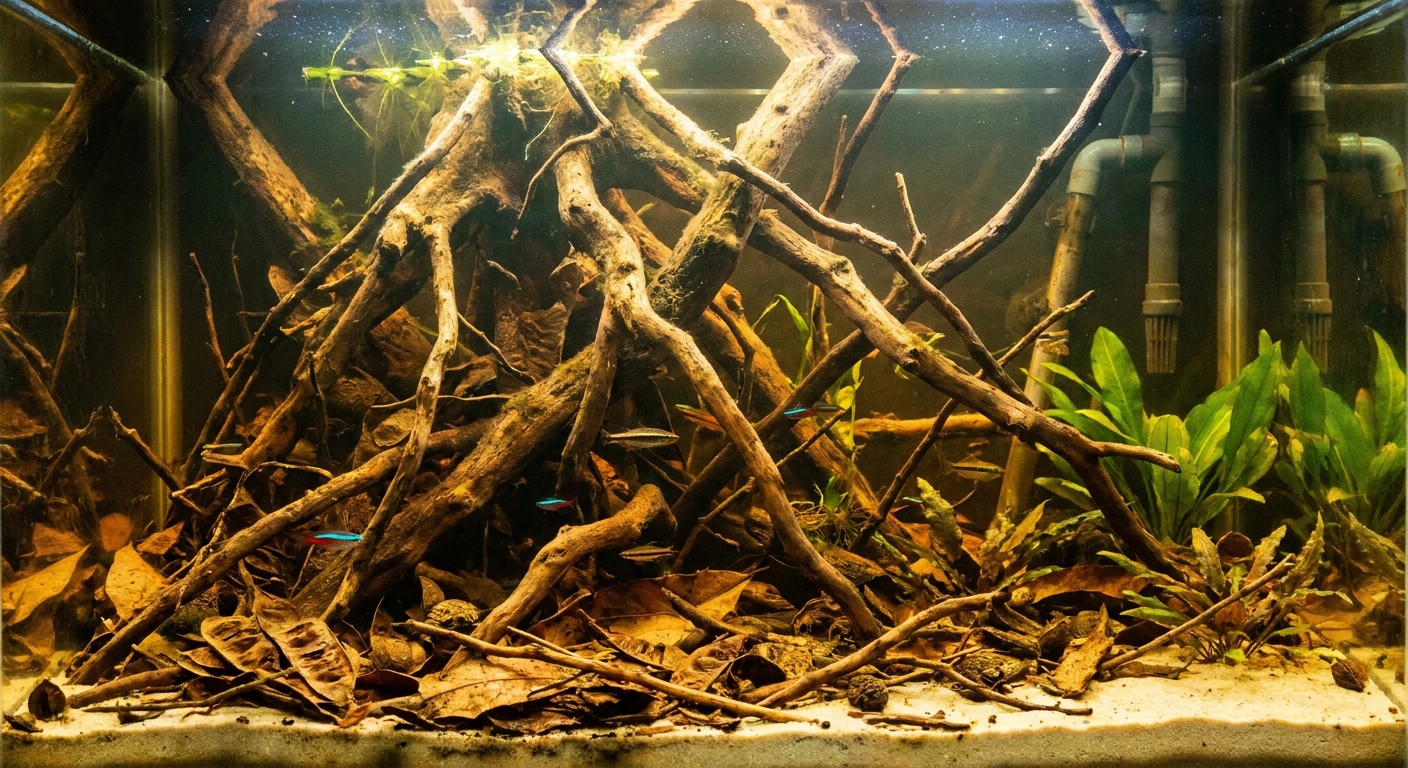
South American river systems are diverse, but many classic Amazon-inspired aquariums share a few visual and environmental cues:
- Root-heavy hardscape: Branches and roots form overhead cover and shaded swim-throughs.
- Fine sand: Light beige to tan sand reads as river margin and helps bottom-dwellers forage naturally.
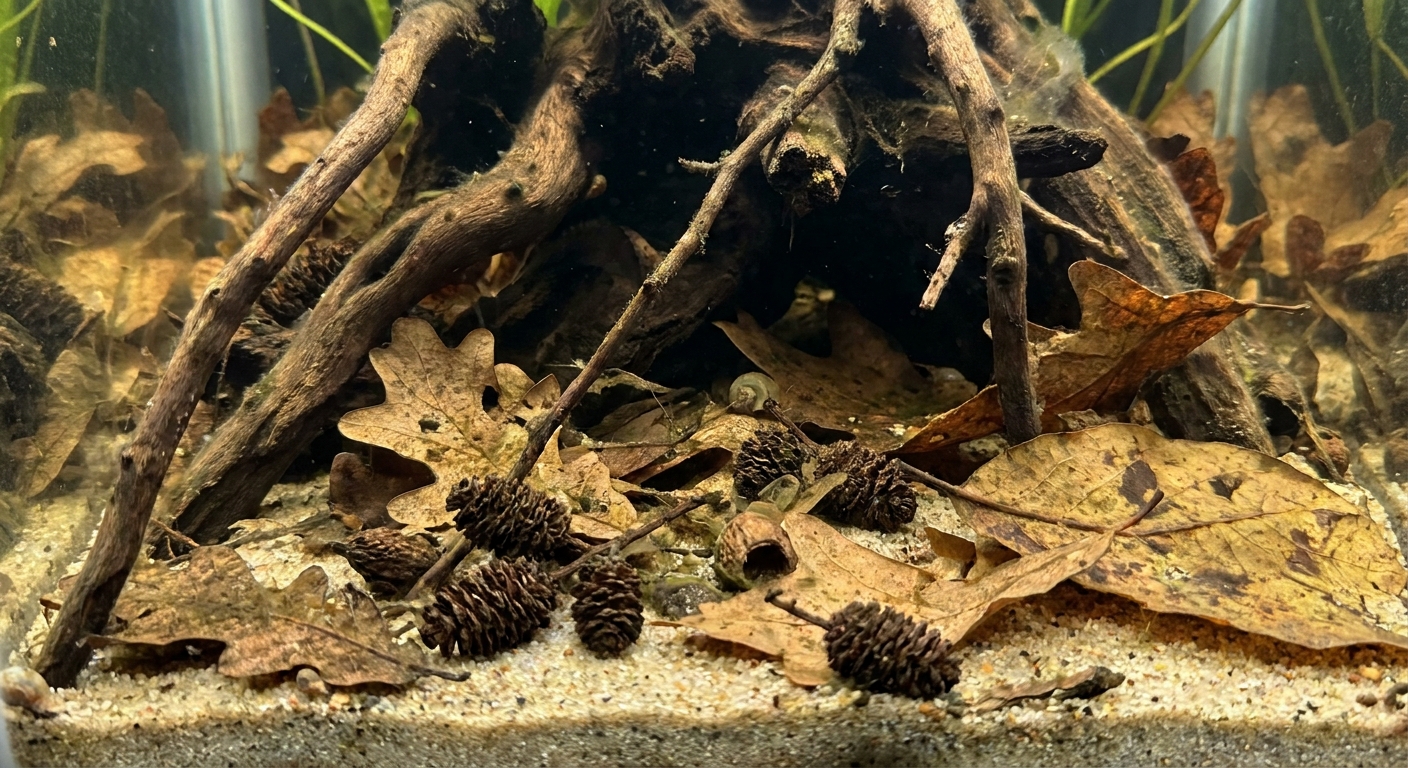
- Leaf litter and seed pods: Botanicals add texture, microhabitats, and that calm blackwater tint.
- Selective, region-fitting plants: Many Amazon areas are plant-light in the main channel, with heavier growth at edges and floodplains.
- Gentle current: Flow should feel like a broad river, not a mountain stream.
If you want a more “aquascaping layout” approach while staying believable, lean on composition basics like depth cues and focal placement. Verdant Aqua’s guides to creating depth and golden ratio focal points translate beautifully into biotope work, especially when roots replace stones as the main structure.
Pick your water story
It helps to choose one “water story” before you buy anything. This sets the color palette, botanicals, and plant density.
Blackwater
- Look: Amber to tea-colored water, leaf litter, lots of wood, dimmer feel.
- Why it works in aquascaping: Botanicals do a lot of the visual heavy lifting, and fish colors pop.
- Planting: Often sparse in true blackwater streams, but edge plants can be used tastefully.
Clearwater
- Look: Neutral water color, sand, roots, brighter highlights.
- Planting: Moderate to heavy can work if you keep it edge-focused and use South American species.
Whitewater
- Look: Sediment-rich in nature. In home aquariums, true, persistent turbidity is hard to maintain attractively and can complicate filtration and light penetration, so most hobbyists approximate the feel with warm sand, strong riverbank structure, and robust flow rather than keeping suspended sediment.
- Planting: Often less plant-forward. Hardscape and fish behavior become the stars.
Most hobbyists aiming for that unmistakable “Amazon vibe” choose blackwater or clearwater with blackwater accents.
Hardscape: roots like a riverbank
If there’s one shortcut to “Amazon,” it is wood that looks like it grew there. Instead of centering a dramatic bonsai shape, think like a river: roots grab the bank, water undercuts them, branches fall and tangle.
Root rules that stay believable
- Anchor from one side: Build the main root mass from the left or right third of the tank, then let finer branches reach across.
- Make shade zones: Create at least one darker cavern or arch where fish can retreat.
- Follow one flow direction: Angle thinner branches and leaf litter drift the same way, as if current placed them.
- Keep the sand open: Amazon scenes often have big negative spaces. Leave a wide foraging lane in front.
- Break symmetry: Rivers rarely mirror themselves. Use uneven heights and irregular spacing.
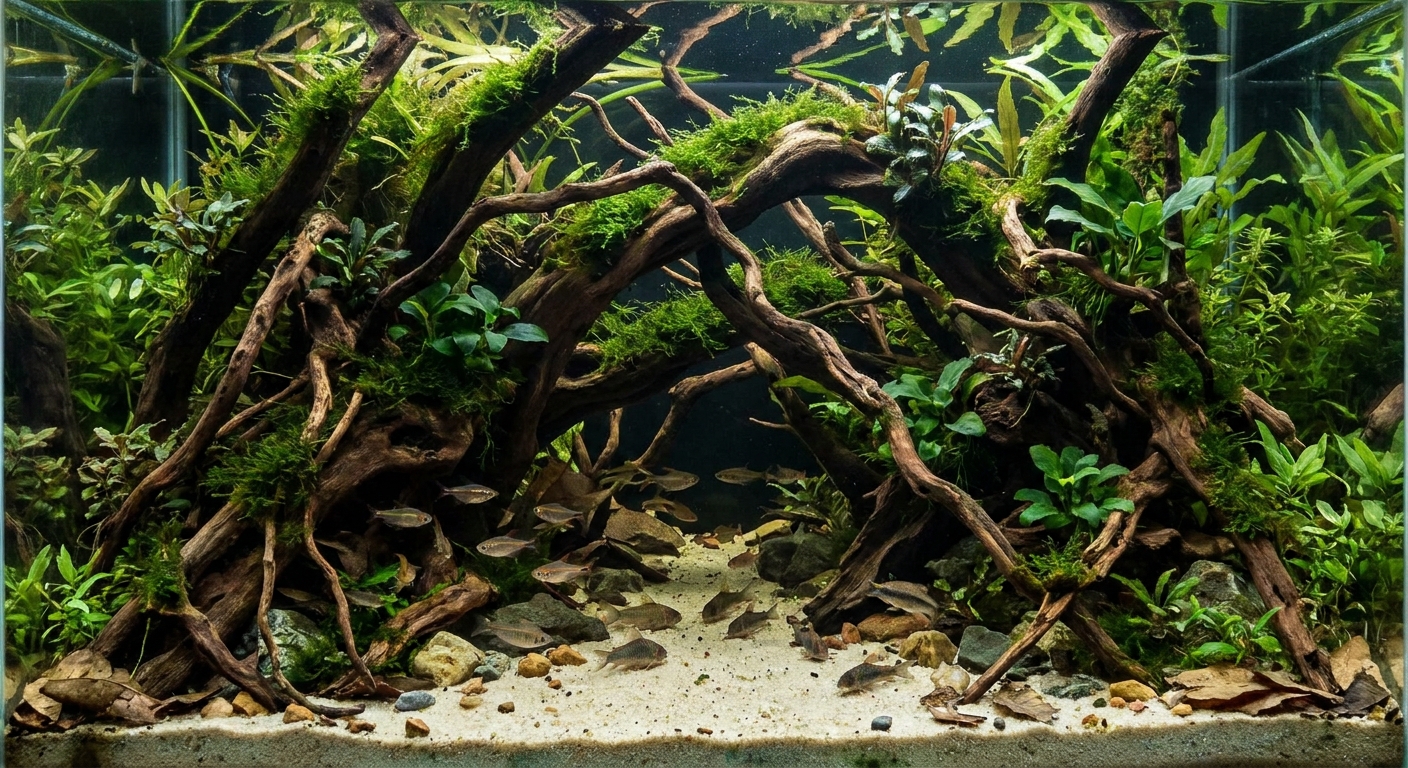
If you like mixing stone with wood, keep rock subtle and sediment-worn. Avoid sharp, high-contrast “mountain” stone arrangements unless you are intentionally blending styles. For a natural transition, see blending driftwood and rocks naturally.
Substrate and riverbed details
An Amazon biotope riverbed is usually simple up close, but rich in tiny details.
Substrate choices
- Fine sand (0.2 to 1 mm): The classic. Great for corydoras and natural leaf scatter.
- Very small rounded gravel: Acceptable if you want slightly more texture, but keep it light and natural.
- Plant soil: Use underneath only if needed, capped with sand so the surface still reads as riverbed.
Details that sell the scene
- A thin leaf line where debris collects along the down-current edge of wood.
- One or two slightly raised sand bars, not a whole terrace system.
- Scattered twigs and tiny branch pieces that look like flood debris.
When you build depth, let the sand slope gently up toward the back and tuck leaf litter into back corners. That keeps maintenance easier and makes the tank feel longer.
Botanicals: tint without soup
Botanicals are where the Amazon biotope becomes a living little forest floor. They also change water chemistry and filtration behavior, so it helps to be intentional.
Common botanicals and what they do
- Leaf litter: Indian almond leaves are widely used in aquariums. For a more region-inspired look, mix in different leaf shapes when available from reputable aquarium botanical sellers.
- Seed pods and cones: Add structure, grazing surfaces, and slow tannin release.
- Bark and twigs: Great for authenticity, but use only aquarium-safe sources sold for aquarium use to avoid pesticides and contaminants.
What not to use
If you are tempted to collect leaves or branches outdoors, pause. Unknown tree species, roadside plants, and yard trimmings can carry pesticides, fertilizers, sap, or oils that do not belong in your river scene. For a calmer, safer build, stick to botanicals sold specifically for aquarium use unless you are 100 percent confident in identification and cleanliness.
How to prepare botanicals
- Rinse well to remove dust.
- Optionally pre-soak for a few days to reduce the first big tannin burst and help pieces sink.
- Skip boiling when possible if your goal is long-lasting tannins and biofilm. Boiling can strip a lot of what makes botanicals special.
How much tint is right
In a display aquarium, a soft amber tint is often the sweet spot: it looks natural, fish still photograph nicely, and plants still get usable light. If you want deeper tea color, balance it with brighter lighting and extra attention to oxygenation and surface movement.
For the maintenance side of blackwater, including managing tint, debris, and filter flow, Verdant Aqua’s maintenance and troubleshooting hub is a helpful companion.
Plant lists with honest geography
Not every “Amazon-looking” plant is actually from the Amazon basin. Below are a few options, with placement notes and clear labels so you can keep it strict or inspired without surprises.
Foreground and margins
- Helanthium tenellum (pygmy chain sword): low, grassy patches along edges and open sand transitions. Good for strict and inspired.
- Helanthium bolivianum (chain sword): slightly taller, great for gentle thickets near the bank. Good for strict and inspired.
- Hydrocotyle leucocephala (Brazilian pennywort): can trail and arch, best used near wood and margins rather than carpeting the whole tank. Good for strict and inspired.
Midground
- Echinodorus bleheri and other Echinodorus (Amazon swords): iconic centerpiece plants, but use sparingly in true riverbank compositions. One strong clump can be enough. Good for strict and inspired.
- Myriophyllum mattogrossense: fine texture that feels like soft river vegetation when kept in controlled groups. Good for strict and inspired.
- Ludwigia repens: commonly used in “Amazon style” tanks, but it is not Amazon basin native. Use it only for Amazon-inspired layouts, or swap it for more region-correct choices available in your area.
- Bacopa caroliniana: popular and hardy, but not Amazon basin native. Best kept for Amazon-inspired layouts.
Background and floodplain feel
- Cabomba species: feathery, dramatic, and often sold under changing trade names. Availability and legality vary by region, so choose carefully and treat it as inspired unless you have confirmed locality-appropriate sourcing.
- Echinodorus species as a backdrop: larger swords can create that flooded-forest edge feeling when kept in one or two heavy groups. Good for strict and inspired.
- Vallisneria americana: not a good strict Amazon biotope choice. If you love the “river grass” look, use it only for Amazon-inspired layouts and keep it as a soft backdrop, not a wall.
Epiphytes on roots
Many popular epiphytes are not South American. If your goal is strict, keep epiphytes minimal and let wood, leaf litter, and swords define the scene. If your goal is inspired, you can use a small amount, but keep it subtle so the tank still reads as river, not rock garden.
For more plant-by-plant care and placement ideas, visit Aquatic Plants.
Water and environment
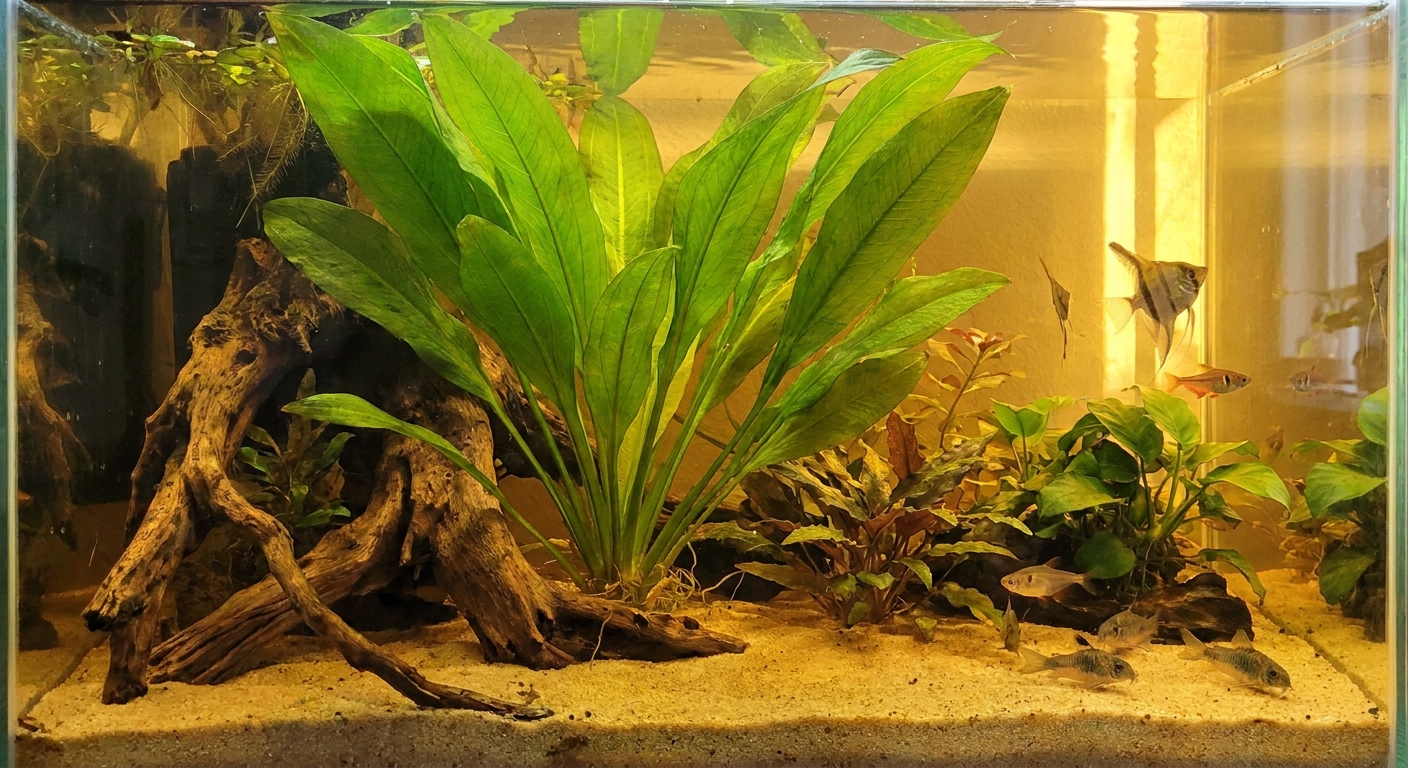
A biotope feels authentic when livestock behaves naturally. That starts with stable, appropriate conditions.
- Temperature: Many Amazon species do well around 24 to 28 C, depending on the exact fish and plants.
- pH and hardness: Soft to moderately soft water is common for Amazon community fish. Blackwater setups often trend more acidic.
- Flow: Moderate, even circulation. A simple rule: aim for a gentle surface ripple and moving leaf edges, but no sand dunes or blasted bare patches.
- Lighting: Medium light is plenty for most Amazon-style planting, especially with tannins. If you run strong light, plan for algae prevention and trimming.
- Filtration and oxygen: Warm water holds less dissolved oxygen, and heavy botanicals can increase oxygen demand as they break down and fuel microbial life. Tannins mainly tint the water, they do not meaningfully remove oxygen on their own. Keep gas exchange strong without turning the tank into a washing machine.
Soft water stability
Very soft water can be wonderfully Amazon-like, but it can also be swingy. My gentle fish-first approach is to prioritize stability over chasing a number. Make changes slowly, keep water change routines consistent, and avoid sudden large botanical dumps that can shift conditions quickly in a small tank.
Need help matching filtration, heaters, CO2, and lighting to the layout? The Equipment & Setup section can help you build a stable foundation.
Step-by-step build
1) Plan the bank and the channel
Sketch two zones: a rooty riverbank on one side and an open sandy channel across the front. Decide where the main focal point sits, usually where the thickest roots emerge.
2) Place wood first, then lock the story
Set the biggest wood pieces so they look anchored into the bank. Add thinner branches to create direction and shade. Step back and check that the eye flows from the bank into open water, not into a dead end.
3) Add sand and keep the negative space clean
Build a gentle slope toward the back. Keep the front sandbed broad. This is where corys, sand-sifters, and leaf drift patterns look most natural.
4) Plant like a river edge
Cluster plants in pockets near wood and along margins. Avoid evenly spaced stems across the whole back wall. Rivers are patchy.
5) Add botanicals last
Scatter leaves in a few natural collections: behind roots, in corners, and along the down-current side of hardscape. Drop in pods sparingly. A little goes a long way.
6) Fill gently and tune the current
Pour onto a plate or bag to avoid sandstorms. Adjust the outflow so leaf litter drifts slightly but does not pile up everywhere.
Livestock ideas
Pick fish that use the tank the way the river scene suggests: dither fish in midwater, bottom foragers on sand, and calm centerpiece species that appreciate cover.
- Schooling midwater: many tetras and hatchetfish species suit Amazon themes.
- Bottom activity: Corydoras on fine sand are a perfect match for leaf litter edges.
- Algae and biofilm grazers: choose species compatible with your temperature and water softness.
- Centerpiece behavior: dwarf cichlids often appreciate roots, caves, and shaded pockets.
A note on sand-sifters like Geophagus: they can be incredible in the right tank, but many species get large, redecorate constantly, and can uproot plants. If you want that behavior, build the layout around it with tougher planting and extra open sand, and do a little homework before you commit.
Keep stocking conservative in deep blackwater style tanks, since warm water and heavy organics make oxygen management more important.
Maintenance
Leaf litter management
- Remove only the leaves that are fully breaking down if you want a cleaner look.
- Top up leaves periodically instead of dumping a huge batch all at once.
Sandbed care
- Hover the siphon just above the sand to lift debris without vacuuming sand away.
- Let some mulm remain under wood and botanicals. It looks natural and feeds microfauna.
Algae prevention in tinted tanks
- Keep photoperiod reasonable. Tannins do not automatically prevent algae.
- Prioritize plant health and stable CO2 if you use it.
- Do not overclean biological surfaces like wood and botanicals. Biofilm is part of the ecosystem.
Common mistakes and fixes
- Mistake: Too many plant species everywhere. Fix: Reduce to a few groups and keep plants mostly along margins.
- Mistake: Wood looks placed, not grown. Fix: Rotate pieces so they enter the substrate, then add thinner branches that unify direction.
- Mistake: Water turns murky, not tinted. Fix: Increase mechanical filtration, rinse botanicals better, and avoid stirring deep detritus in the sand all at once.
- Mistake: Tank feels dark and lifeless. Fix: Use lighter sand, open more negative space, and concentrate botanicals in intentional drifts instead of covering everything.
Quick start checklist
- Choose blackwater, clearwater, or a clearwater base with blackwater accents.
- Decide strict biotope or Amazon-inspired up front.
- Build one strong root bank and one open sandy channel.
- Use botanicals in clusters, not a uniform layer.
- Plant in pockets along edges, with South American species first.
- Tune gentle flow and stable warm conditions for fish behavior.
- Maintain the sandbed lightly and refresh leaf litter gradually.
With a warm wave of my little antennae, consider this your permission to keep it simple. A believable Amazon biotope is often quieter than a contest aquascape, but that is exactly what makes it feel so alive.
More layout inspiration is waiting in Aquascaping Design, and you can always peek at my author page at Sprout.